Frequently Asked Questions
The most-asked questions about Scarlet frogfish.
What exactly is a Scarlet frogfish?
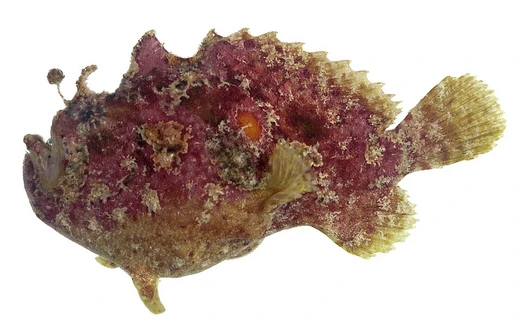
It is a small, vividly colored member of the anglerfish family (Antennariidae) recognized for its dominant scarlet or red body coloration. Unlike most fish, it has a flattened, lumpy body shape that lets it sit inconspicuously among coral and sponge reefs.
Where do they live in the wild?
Scarlet frogfish are found on shallow tropical and subtropical reefs throughout the Indo-Pacific, generally from a few meters down to about 30 meters. They favor mixed hard- and soft-coral habitats where their red coloration blends with anemones, sponges, and live rock.
How do they hunt?
They are pure ambush predators: the frogfish sits perfectly still and dangles a modified dorsal-fin spine (the illicium) tipped with a fleshy lure called an esca in front of passing small fish or crustaceans. When prey strikes the lure, the frogfish engulfs it in a single rapid suction bite.
How big do they get?
Most individuals measure roughly 10 to 15 centimeters from snout to tail, with occasional specimens approaching 20 centimeters. Their stocky, compact build makes them look larger than their length suggests.
Are they dangerous to people?
No. Scarlet frogfish lack venom, sharp teeth, and any other means of harming humans. They are entirely harmless and are sometimes gently handled by divers and marine researchers without incident.
Can you keep one in a home aquarium?
It is possible but demanding; they require a well-cycled reef tank with ample live rock, stable water parameters, and a regular supply of small live or frozen prey. They are sensitive to sudden water-quality changes and can be shy, so experienced aquarists are strongly advised.
How do they reproduce?
They are broadcast spawners: the female releases a cloud of buoyant eggs into the water column and the male fertilizes them externally. The tiny larvae drift as plankton for a period before settling onto reefs as miniature, fully formed adults.
How is it different from the more commonly seen painter or variable frogfish?
The primary distinction is coloration—scarlet frogfish display a dominant red or orange-red hue across most of the body, while painter and variable frogfish tend toward mottled browns, yellows, or greens. Internally and behaviorally, the species are very similar in anatomy and hunting strategy.
Why and how do they change color?
They can subtly shift their hue and surface pattern over minutes to hours to better match the surrounding substrate, a form of active camouflage. Stress, mood, and time of day can also influence how vivid or muted their scarlet coloration appears at any given moment.
What is a good starting point for learning more?
Nature-documentary series covering Indo-Pacific reef life frequently feature frogfish in action and provide accessible visual context. For deeper study, peer-reviewed papers on Antennariidae morphology and behavior, or a visit to a public aquarium with a tropical reef exhibit, are both excellent next steps.