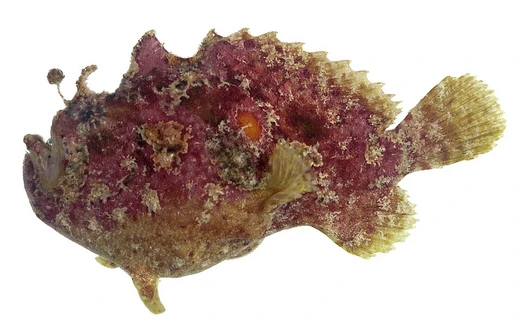
Scarlet frogfish (Abantennarius coccineus)
Source-cited species reference: taxonomy from WoRMS, biology from FishBase, occurrence map from GBIF, conservation from IUCN Red List, description from Wikipedia.

Abantennarius coccineus, the scarlet or freckled frogfish, is a species of frogfish originally classified as Chironectes coccineus and Antennarius coccineus. It lives within tropical waters and has a central distribution being around Indo-East-Pacific areas — excluding Hawaii. The habitat of the scarlet frogfish is in the shallow zones of the ocean. It is found within reef areas, in rocky mounds or sponges where there are places for it to hide amongst from predators. The scarlet frogfish comes in a variety of colours, from tan and brown colours to bright reds and yellows and will grow to a maximum length of 13 cm. It can be identified taxonomically through its pectoral rays, the presence of dark patches that appear on its fins and body, along with its lack of distinctive tail base.
- Scientific name
- Abantennarius coccineus
- Authority
- (Lesson, 1831)
- Family
- Antennariidae
- Order
- Lophiiformes
- Maximum length
- 13 cm
- Depth range
- 10–75 m
- Habitat zone
- reef-associated
- Iucn red list
- Least Concern
- Gbif occurrence records
- 41
A Long and Tangled Naming History
The scarlet frogfish has endured one of the most convoluted taxonomic journeys in the fish world. René Primevère Lesson first described the species in 1831 as Chironectes coccineus, only to reclassify it as Antennarius coccineus within the same year. For decades the name held, until David Starr Jordan and Barton W. Evermann in 1904 lumped it together with Antennarius drombus, a decision later reversed once researchers noticed differences in pectoral ray counts, esca coloration, and the density of dark body blotches. The confusion did not end there. Between 1904 and 1970, at least six other scientists assigned the fish entirely different names—nexilis, stigmaticus, leucus, neocaledoniensis, moai, and immaculatus—each reflecting a partial or mistaken identification. It was not until 2012 that DNA profiling and genetic analysis finally placed the species outside the Antennarius genus, confirming its true lineage and settling a naming dispute that had spanned nearly two centuries.
A Master of Disguise in Miniature
Standing at no more than thirteen centimetres when fully grown, the scarlet frogfish is a compact, scaleless creature whose stocky, unstreamlined body is built for stillness rather than speed. Its colour palette is remarkably diverse, ranging from pale tan and mottled brown to vivid reds and yellows, often peppered with small dark spots across the body and fins. The fish's most striking feature is the growth atop its head—a lure that can appear as anything from a simple unpigmented tissue lump to a long, elaborate protuberance. Other distinguishing traits include a split last pelvic fin ray, a curved second dorsal fin, and an illicium measuring only about nine percent of the length typical for frogfish. The absence of a distinctive tail base, the lack of a dark patch on the dorsal fin, and the missing spines along the back further set it apart from close relatives, making each individual a subtle but unmistakable signature of its own species.
Ambush, Mimicry, and Jet-Propelled Strikes
Though small, the scarlet frogfish is a relentless predator that will consume virtually any prey that drifts within reach. It lives a solitary, bottom-dwelling existence, tolerating its own kind only during the brief window of fertilization. When a predator approaches, the frogfish first freezes, relying on its mottled camouflage to vanish against reef rock or sponge. If that fails, it escalates to Batesian mimicry, settling onto the seafloor in the posture of a venomous sea urchin or adopting the threatening stance of a scorpionfish. Should an attacker actually strike, the frogfish inflates its entire body with water using powerful oral suction, making itself nearly impossible to swallow. Perhaps most remarkably, the species possesses a jet-propulsion mechanism: it draws water into its mouth and forcefully expels it through gill openings positioned behind the pectoral fins, launching itself forward in a burst that aids ambush strikes. Although primarily active at night, it will still hunt during daylight hours.
A Solitary Life and a Brief, Buoyant Romance
Outside of the mating season, the scarlet frogfish is essentially a loner, spending its days and nights hidden among reef crevices, rocky mounds, and sponge clusters in the shallow tropical waters of the Indo-East-Pacific. It poses no threat to humans and is not targeted by commercial fisheries, though it has occasionally appeared in research sampling aimed at gauging reef-fish abundance or as incidental bycatch in shrimp trawling nets. Reproduction is the one exception to its solitary rule. When a female is ready, she begins producing eggs, and the added mass causes her body to bloat noticeably, increasing her buoyancy. This swelling serves as a visual signal to males, who may shadow a receptive female for as long as two days. The male then nudges her, and together, riding her extra lift, they rise toward the surface to complete fertilization. Once that brief encounter ends, each frogfish returns to its quiet, solitary existence on the reef floor.
Frequently Asked Questions
What is the Scarlet frogfish (Abantennarius coccineus)?
It is a small tropical frogfish in the family Antennariidae, first formally described by Lesson in 1831. The species belongs to the order Lophiiformes and is recognized for its striking color range, spanning muted tans and browns up to vivid reds and yellows.
Where does the Scarlet frogfish live in the wild?
This frogfish occupies shallow reef zones, rocky mounds, and sponge-covered areas throughout the Indo-East-Pacific, though it is notably absent from Hawaiian waters. Its typical depth range falls between 10 and 75 meters.
How big does the Scarlet frogfish get?
An individual reaches a maximum length of roughly 13 centimeters, keeping it a compact reef dweller. That small stature allows it to tuck into crevices among rocks and sponges to avoid larger predators.
Why does the Scarlet frogfish come in so many different colors?
Rather than a single fixed hue, the species displays a broad palette from earthy tans to bright reds and yellows. This variation most likely helps each individual blend into the diverse backgrounds of its reef, sponge, and rocky-mound habitats.
What makes the Scarlet frogfish a favorite among underwater photographers and marine biologists?
Its compact size, remarkable color diversity, and effective camouflage among reef structures make it a visually rewarding subject to observe. It also serves as a useful indicator of healthy shallow reef ecosystems across the Indo-Pacific.
Spotted an error? Know more?
Reader corrections go straight into our review queue. Suggest an edit · How this site is sourced