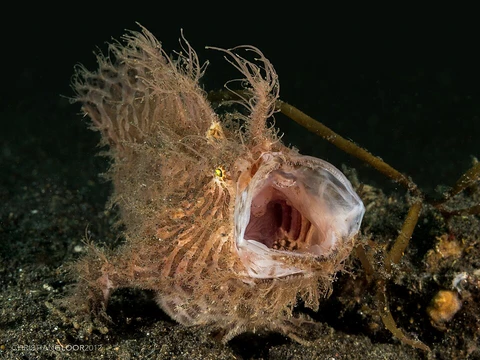
Island frogfish (Abantennarius bermudensis)
Source-cited species reference: taxonomy from WoRMS, biology from FishBase, conservation from IUCN Red List, description from Wikipedia.

Abantennarius bermudensis, the island frogfish, is a species of marine ray-finned fish belonging to the family Antennariidae, the frogfishes. The island frogfish is found in the Western Atlantic Ocean.
- Scientific name
- Abantennarius bermudensis
- Authority
- (Schultz, 1957)
- Family
- Antennariidae
- Order
- Lophiiformes
- Maximum length
- 7.599999904632568 cm
- Depth range
- 4–30 m
- Habitat zone
- reef-associated
- Iucn red list
- Least Concern
Taxonomy & the Story Behind the Name
The island frogfish received its formal scientific description in 1957, when American ichthyologist Leonard Peter Schultz published it under the name Antennarius bermudensis, designating Hungry Bay in Paget County, Bermuda, as the type locality. Within the broader classification of marine ray-finned fishes, it sits in the family Antennariidae, nested under the suborder Antennarioidei and the order Lophiiformes—the anglerfishes. The genus name Abantennarius carries a deliberate morphological reference: the prefix 'ab' (meaning 'away from') is attached to 'antennarius,' pointing to a distinctive anatomical feature where the gill opening sits displaced from the base of the pectoral fin, a position that differs from the typical arrangement seen in other frogfishes. The species epithet bermudensis simply anchors the fish to its island of first discovery. Together, these nomenclatural choices encode both a geographic origin and a subtle structural distinction that separates this small marine fish from its close relatives within the anglerfish order.
Physical Form & Colour Pattern
The island frogfish presents a compact, subglobular silhouette with slight lateral compression, reaching a maximum published standard length of just 7.6 centimetres. Its head is smooth and unspined, dominated by large laterally positioned eyes, while the mouth angles upward and is lined with small, sharp teeth. A small, round bill opening sits beneath and behind the pectoral-fin base. The illicium—the modified first dorsal spine—measures shorter than the second dorsal spine and bears an elongated, tapering esca tipped with filaments and dark swellings at its base. The pectoral fins are arm-like, featuring a joint that resembles an elbow. The second dorsal fin carries twelve soft rays and the anal fin seven, with membranes at their rear edges connecting to the caudal fin. The skin feels rough due to a dense covering of bifurcated spinules. Colouration ranges across yellow, tan, or brown, patterned with brown spots and mottles that may merge into irregular bars across the tail. A distinct dark eyespot marks the upper body beneath the centre of the second dorsal fin, and between zero and seven dark bars can radiate from the eye.
Geographic Range & Reef Habitat
The island frogfish inhabits a broad swath of the Western Atlantic Ocean. Its northernmost recorded range extends to Bermuda, while its distribution stretches southward through the Bahamas, off northwestern Cuba, and across the Gulf of Mexico from the Arrowsmith Bank near Mexico to the waters surrounding Cuba, Hispaniola, and Puerto Rico. The range continues along the northern coast of South America, spanning from Colombia eastward to Tobago. Within this geographic span, the species is consistently associated with reef environments, occupying waters that range from four to thirty metres in depth. This depth window places it in the sunlit, structurally complex zone where rocky outcrops and coral formations provide both shelter and hunting grounds. The association with reefs across such a wide latitudinal band—from the subtropical waters around Bermuda to the tropical Caribbean and northern South American shelf—suggests a degree of ecological flexibility within a relatively narrow depth corridor, though the specific biology and ecology of this small frogfish remain poorly documented in the scientific literature.
Ambush Hunting & Reproductive Biology
As an ambush predator, the island frogfish relies on patience rather than pursuit. It moves slowly along the substrate of rocky and coral reefs, using its arm-like pectoral fins to crawl across the seafloor. When a suitable prey item drifts close, the fish extends its illicium and the elongated esca at its tip, wiggling the filaments and dark swellings to mimic a small invertebrate or lure. This display draws smaller fishes within striking range of the upward-pointing, tooth-lined mouth, where they are swiftly engulfed. On the reproductive side, females are believed to produce more than ten thousand eggs per spawning event, a strategy that likely compensates for the low survival rate of individual offspring in the open reef environment. Despite these known behavioural and reproductive traits, the broader biology and ecology of Abantennarius bermudensis remain poorly understood. Much of what is known comes from limited collections and the original 1957 description, leaving significant gaps in our understanding of its life history, population dynamics, and ecological interactions within reef communities across the Western Atlantic.
Frequently Asked Questions
What is the Island frogfish (Abantennarius bermudensis)?
It is a small marine ray-finned fish placed in the frogfish family Antennariidae, order Lophiiformes. The species was formally described by Schultz back in 1957 and is restricted to the Western Atlantic Ocean.
Where does the Island frogfish live in the wild?
You'll find it along the Western Atlantic coast, typically on reef or rocky substrates between roughly 4 and 30 metres deep. It stays in relatively shallow, coastal waters rather than open ocean or the deep sea.
How big does an Island frogfish grow?
Adults top out at just under 7.6 cm (about 3 inches) in total length, making it one of the smaller members of the frogfish family. Its compact size helps it blend among coral and sponge crevices where it ambits prey.
What hunting strategy does the Island frogfish use?
Like other antennariids, it is a sit-and-wait ambush predator that camouflages itself against the substrate and lures small fish or crustaceans with its modified first dorsal-fin ray (the illicium and esca). It then snaps its mouth open to engulf anything that drifts close enough.
Why is the Island frogfish notable among frogfish species?
It is one of the few Antennariidae documented specifically to the Western Atlantic, giving it a geographically distinct niche compared to the many Indo-Pacific congeners. Its small maximum size and narrow depth window (4–30 m) also set it apart from larger, deeper-ranging frogfish relatives.
Spotted an error? Know more?
Reader corrections go straight into our review queue. Suggest an edit · How this site is sourced