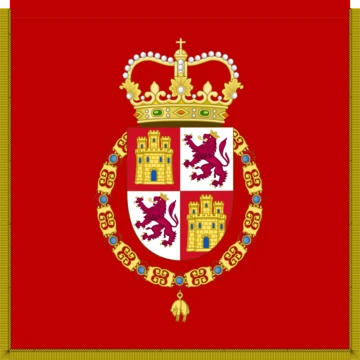
Spanish treasure fleet
Convoy system linking Spain with its American colonies (1566–1790).
The Spanish treasure fleet, also known as the West Indies Fleet or Flota de Indias, was a convoy system of sea routes organized by the Spanish Empire from 1566 to 1790. It linked Spain with its American territories across the Atlantic, transporting a wide variety of goods including silver, gold, gems, spices, and agricultural products. The fleet was the first permanent transatlantic trade route in history and, along with the Manila galleon trade, made possible key components of today's global economy.
Quick Facts
- Start year
- 1566
- End year
- 1790
- Primary spanish ports
- Seville, Cádiz
- Tax on private merchants
- 20% (quinto real)
- Total silver produced (estimated)
- 4 billion pesos
Facts from the source article.
Did You Know?
- Only the Dutch WIC admiral Piet Hein managed to capture an entire fleet, in the Battle in the Bay of Matanzas in 1628.
- The English admiral Robert Blake twice attacked the fleet, in the Battle of Cádiz in 1656 and in the Battle of Santa Cruz de Tenerife in 1657, but captured only a single galleon.
- The San José, sunk in 1708, was discovered in 2015 and its location is a national secret; in November 2023 the Colombian government looked to recover the treasure.
History
The Spanish began shipping New World goods back to Europe right after Columbus’s first voyage in 1492. Even before the convoy system was formalized in 1564, Spain tried to protect its ships by guarding the waters around Cuba, southern Spain, and the Canary Islands from pirates and enemy navies. The turning point came in the 1560s, when French privateers sacked Havana, prompting the Spanish crown to set up a regular convoy network. Admiral and shipbuilder Bernardino de Mendoza first proposed the main rules during the reign of Emperor Charles V, and later Admiral Pedro Menéndez de Avilés, a trusted adviser to King Philip II, helped put them into practice. Two main sea routes were used. The Caribbean fleet, or Flota de Indias, sailed from Seville in two convoys to ports like Veracruz, Portobelo, and Cartagena, then gathered in Havana for the return trip. The second route was the Manila Galleon, which crossed the Pacific from the Philippines to Acapulco, Mexico. Asian goods were then carried overland by mule to Veracruz and loaded onto the Caribbean fleet for Spain. To better protect this trade, Menéndez de Avilés and Álvaro de Bazán designed the classic galleon in the 1550s. All trade was controlled by the Casa de Contratación in Seville, the only legal Spanish port for colonial commerce. Underwater archaeology has since revealed that more goods were often shipped than the official records in the Archivo General de Indias show. Some Spanish merchants, or cargadores acting for foreign traders, used the fleets to move goods, and many smuggled cargo to avoid taxes. The crown collected a 20% tax, the quinto real, on private merchants’ wares and precious metals.
The fleets
Every year, two fleets left Spain loaded with European goods in demand in Spanish America, guarded by military vessels. Valuable cargo from the Americas, most significantly silver from Mexico and Peru, were sent back to Spain. Fleets of fifty or more ships sailed from Spain, one bound for the Mexican port of Veracruz and the other for Panama and Cartagena. From Seville or Cádiz, the two fleets sailed together down the coast of Africa and stopped at the Canary Islands for provisions before crossing the Atlantic. Once in the Caribbean, the fleets separated. The New Spain fleet sailed to Veracruz to load silver, cochineal, and Asian goods such as porcelain and silk shipped from China on the Manila galleons, which were carried overland from Acapulco by mule train. The Tierra Firme fleet sailed to Cartagena to load South American products, especially silver from Potosí; some ships went to Portobello to load Peruvian silver shipped from Callao and transported across the isthmus of Panama by mule. Other ships went to Margarita island off Venezuela to collect pearls. After loading, both fleets sailed for Havana to rendezvous for the return journey to Spain. The overland journey by mule train and supplies provided by local farmers invigorated the colonial economy, requiring porters, innkeepers, and foodstuffs. In Mexico in 1635, a sales tax increase was levied to finance the Armada de Barlovento. Between 1703 and 1705, Spanish corsair Amaro Pargo began participating in the West Indies Fleet, sailing from Santa Cruz de Tenerife to Havana and reinvesting benefits in his estates devoted to grape cultivation.
The flow of Spanish treasure
The Spanish treasure fleet carried enormous wealth, measured in pesos, each containing about 25 grams of silver. A single galleon could hold up to 2 million pesos. Over three centuries, roughly 4 billion pesos were produced, worth around US$530 billion or €470 billion at 2015 silver prices. Of that total, 2.5 billion pesos were shipped to Europe, with 500 million of that continuing around Africa to Asia. Another 650 million pesos went directly from Acapulco to Asia, while 850 million remained in the Americas. Spain itself kept little of this wealth. In 1590, of the 11 million pesos arriving, 2 million paid for French imports, 6 million went to Italy for imports and military costs (2.5 million of that traveled the Spanish Road to the Low Countries), and 1 million went to the Ottoman Empire. Portugal shipped 1.5 million pesos onward to Asia. Of the 2 million pesos reaching the Dutch Republic that year, 75% bought naval stores in the Baltic and 25% went to Asia. The Spanish crown’s total annual income was about 2.5 million pesos in 1550, rising to 14 million in the 1590s, 15 million in 1760, and 30 million in 1780. By 1665, the crown owed 30 million pesos in short-term debt and 300 million in long-term debt. Most New World production was silver, though Colombian mines yielded mostly gold. The crown legally claimed one-fifth (the quinto real) at the source, plus additional taxes. These figures cover only legal production, excluding the growing smuggling after 1600.
Famous shipwrecks
Wrecks of Spanish treasure ships, whether sunk in naval combat or, more usually, by storms (with those occurring in 1622, 1715, 1733, and 1750 being among the worst), are a prime target for modern treasure hunters. Many, such as the Nuestra Señora de Atocha and the Santa Margarita, have been salvaged. In August 1750, at least three Spanish merchantmen ran aground in North Carolina during a hurricane: the El Salvador sank near Cape Lookout, the Nuestra Señora De Soledad went ashore near present-day Core Banks, and the Nuestra Señora De Guadalupe went ashore near present-day Ocracoke. The wreck of the Spanish merchant ship Encarnación, part of the Tierra Firme fleet, was discovered in 2011 with much of its cargo still aboard and part of its hull intact; it sank in 1681 during a storm near the mouth of the Chagres River on the Caribbean side of Panama in less than 40 feet of water. The remains of the Urca de Lima from the 1715 fleet and the San Pedro from the 1733 fleet are now protected as Florida Underwater Archaeological Preserves. The Capitana (El Rubi), flagship of the 1733 fleet, ran aground during a hurricane near Upper Matecumbe Key; three men died, and divers later recovered most of the treasure. The Capitana was found again in 1938, and additional gold was recovered in June 2015. The San José was sunk in 1708 by British forces near Colombia's coast; its wreckage was discovered in 2015 and is believed to contain a record amount of gold, silver, and precious stones. The Nuestra Señora de las Maravillas collided with another ship and sank into a coral reef off the Bahamas in January 1656; its cargo of almost 3.5 million items was recovered between the 1650s and 1990s.
More in Spanish Colonization of the Americas
Spotted an error? Know more?
Reader corrections go straight into our review queue. Suggest an edit · How this site is sourced