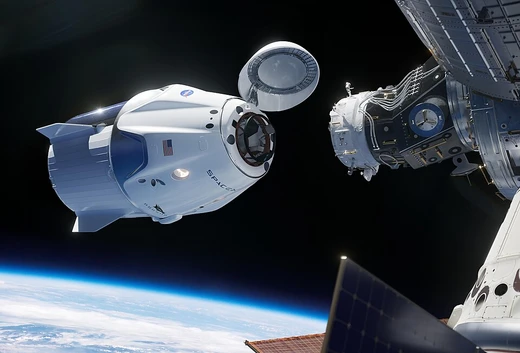
SpaceX Crew-1
First operational Crew Dragon flight to the International Space Station.
Last updated
It launched on November 16, 2020, carrying four astronauts to the International Space Station for a long-duration stay.[1][2] The Crew Dragon spacecraft named Resilience carried astronauts on its first operational flight, designated SpaceX Crew-1.[3] The Commercial Crew Program's first operational mission to the ISS was SpaceX Crew-1.[4][2]
Key facts and history
The launch date was delayed multiple times, including to November 2017 and later into 2019 and 2020.[5][6] Further delays in 2020 were caused by COVID-19 restrictions and an issue with Merlin 1D engine gas generators.[7] Hopkins and Glover were assigned in August 2018, while Walker and Noguchi were added on March 31, 2020.[8][2] The crew named their capsule Resilience, chosen to honor those who suffered hardship in 2020.[9][2]
Resilience launched on a Falcon 9 rocket from Kennedy Space Center Launch Complex 39A at 00:27:17 UTC on November 16, 2020.[1][2] The capsule docked to the International Docking Adapter on the Harmony module on November 17, 2020.[10] Crew-1 broke the record for the longest U.S. crewed vehicle spaceflight on February 7, 2021, surpassing the 84-day Skylab-4 mark.[4] NASA initially called this mission USCV-1 in 2012, with a planned launch in November 2016.[4][5]
Mike Hopkins, Victor Glover, and Shannon Walker from NASA, plus JAXA's Soichi Noguchi, made up the crew.[1] The mission concluded with a splashdown at night on May 2, 2021; this was the first such nighttime return for NASA astronauts since the Apollo 8 mission in 1968.[4]
What the cited sources add
The NASASpaceFlight.com account notes that Crew-1 was the first American spaceflight to ferry astronauts to the ISS for a long-duration stay since STS-128 in 2009.[2] In July 2022, debris from the Crew-1 Dragon capsule was reported to have crashed into a farm in Australia.[11]
References
- Wikipedia, "SpaceX Crew-1" (CC BY-SA 4.0), which cites: Corbett, "With Resilience, NASA and SpaceX Begin Operational Commercial Crew flights", NASASpaceFlight.com, November 15, 2020; Heiney, "NASA, SpaceX Targeting October for Next Astronaut Launch", blogs.nasa.gov}} {{PD-notice, August 14, 2020; Sheetz, "How NASA and SpaceX plan to launch astronauts in May despite a pandemic", CNBC, April 3, 2020; "DM2 CCP Press Kit 2020", Commercial Crew Program, March 24, 2020 (we also read that source) en.wikipedia.org
- Corbett, "With Resilience, NASA and SpaceX Begin Operational Commercial Crew flights", NASASpaceFlight.com, November 15, 2020. facts only, no text reused. nasaspaceflight.com
- Wikipedia, "SpaceX Crew-1" (CC BY-SA 4.0), which cites: NASA, "CCP - Press Kit", Commercial Crew Program, May 25, 2020; Shireman, "HEO NAC May 2020 International Space Station Status", nasa.gov, May 14, 2020; Glover, "1st crewed Dragon Mission=DM-2 or Demo-2. 2nd crewed Dragon Mission (and 1st long duration ISS Mission)=Crew-1 or Crew One", April 12, 2019 (original not read by us) en.wikipedia.org
- Wikipedia, "SpaceX Crew-1" (CC BY-SA 4.0), which cites: Bergin, "USCV-1: NASA planners slip first ISS commercial crew mission to late 2017", NASASpaceFlight.com, April 6, 2013; "April 2021 – Commercial Crew Program", blogs.nasa.gov, April 29, 2021 }} {{PD-notice; NASA, "CCP - Press Kit", Commercial Crew Program, May 25, 2020; Heiney, "NASA, SpaceX to Launch Second Commercial Crew Rotation Mission to International Space Station", nasa.gov, January 29, 2021; "Launch Schedule", Spaceflight Now, October 23, 2020; Chang, "SpaceX Makes First Nighttime Splash Down With Astronauts Since 1968", The New en.wikipedia.org
- Wikipedia, "SpaceX Crew-1" (CC BY-SA 4.0), which cites: Bergin, "USCV-1: NASA planners slip first ISS commercial crew mission to late 2017", NASASpaceFlight.com, April 6, 2013; Bergin, "USCV-1: NASA planners slip first ISS commercial crew mission to late 2017", NASASpaceFlight.com, April 6, 2013 (we also read that source) en.wikipedia.org
- Bergin, "USCV-1: NASA planners slip first ISS commercial crew mission to late 2017", NASASpaceFlight.com, April 6, 2013. facts only, no text reused. nasaspaceflight.com
- Wikipedia, "SpaceX Crew-1" (CC BY-SA 4.0), which cites: "Launch Schedule", Spaceflight Now, October 23, 2020; "NASA, SpaceX Crew-1 Launch Update", Commercial Crew Program, October 10, 2020 (we also read that source) en.wikipedia.org
- Wikipedia, "SpaceX Crew-1" (CC BY-SA 4.0), which cites: Lewis, "Meet the Astronauts Flying SpaceX's Demo-2", NASA}} {{PD-notice, August 3, 2018; Clark, "NASA, JAXA assign two more astronauts to second piloted Crew Dragon flight", Spaceflight Now, March 31, 2020; Gagarin Research and Test Cosmonaut Training Center, "Астронавты НАСА Майкл Хопкинс, Виктор Глоувер и Челл Линдгрен приступили к подготовке в ЦПК", Yuri Gagarin Cosmonaut Training Center, March 18, 2019; Powell, "JAXA has announced long stay visits to the ISS for 2022 and 2023", November 19, 2020 (original not read by us) en.wikipedia.org
- Wikipedia, "SpaceX Crew-1" (CC BY-SA 4.0), which cites: Gebhardt, "Crew-1 has named their Dragon spacecraft. Welcome to the family, Dragon #Resilience.", September 29, 2020; "NASA urges COVID caution for spectators of SpaceX Crew-1 astronaut launch", space.com, November 13, 2020 (original not read by us) en.wikipedia.org
- Wikipedia, "SpaceX Crew-1" (CC BY-SA 4.0), which cites: Burghardt, "Crew Dragon Resilience successfully docks, expands ISS crew to seven", NASASpaceFlight.com, November 17, 2020 (original not read by us) en.wikipedia.org
- Wikipedia, "SpaceX Crew-1" (CC BY-SA 4.0), which cites: "Possible SpaceX debris falls in Australia from Crew-1 Dragon spacecraft", Space.com, July 29, 2022; "The Loop: A huge piece of possible space junk lands on an Aussie farm, sexual assault reports at an all-time high, and a $1.5 billion jackpot", ABC News, July 29, 2022 (original not read by us) en.wikipedia.org
Each numbered sentence above was checked against the source it cites before publication. Sentences citing Wikipedia adapt text from the English Wikipedia article SpaceX Crew-1 (contributors), used under CC BY-SA 4.0; this entry is available under the same licence. Other sources were used for facts only; no text or images are copied from them.
More in SpaceX human spaceflights
Sources
Compiled from Wikipedia and the sources listed below. Text from Wikipedia is available under CC BY-SA 4.0; this entry is adapted from it.
- Wikipedia: SpaceX Crew-1 (CC BY-SA 4.0).
Spotted an error? Know more?
Reader corrections go straight into our review queue. Suggest an edit · How this site is sourced