Frequently Asked Questions
The most-asked questions about space telescopes.
What exactly is a space telescope?
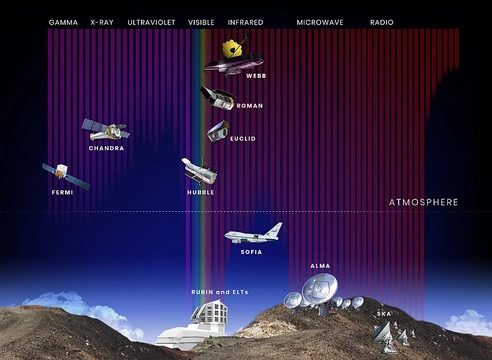
A space telescope is an observatory placed in orbit or at a distant point in space to collect electromagnetic radiation from astronomical sources without interference from Earth's atmosphere. Unlike ground-based telescopes, it can observe wavelengths—such as certain infrared and ultraviolet bands—that are otherwise blocked or distorted by air and water vapor.
Who are the key figures in the history of space telescopes?
Edwin Hubble's pioneering work on distant galaxies lent his name to NASA's most famous observatory, while James Webb, a mid-century NASA administrator, gave his name to its successor. On the engineering front, teams at NASA, ESA, and contractor firms like Northrop Grumman and Ball Aerospace have driven the design and construction of these instruments.
Where should a newcomer start learning about space telescopes?
A good entry point is following the public image releases from Hubble and the James Webb Space Telescope, which are freely available online and visually striking. From there, reading NASA's mission pages or watching the agency's short documentary videos provides context on how each observatory was built and what it is designed to detect.
Why build telescopes in space rather than on the ground?
Earth's atmosphere scatters, absorbs, and distorts incoming light, which blurs fine detail and blocks entire wavelength ranges. A telescope in space sees a steadier, clearer signal and can detect infrared, ultraviolet, and X-ray emissions that never reach the surface.
What is the difference between Hubble and the James Webb Space Telescope?
Hubble, launched in 1990, primarily observes in visible and ultraviolet light from a low Earth orbit roughly 540 kilometers up. JWST, launched in 2021, is optimized for infrared and sits at the second Lagrange point about 1.5 million kilometers from Earth, giving it a much cooler operating environment and access to fainter, more distant sources.
What are some of the most iconic images or discoveries from space telescopes?
Hubble's Deep Field exposures in the 1990s revealed thousands of galaxies in a patch of sky that appeared empty to the naked eye, reshaping estimates of the universe's galaxy population. JWST's early infrared images of the Pillars of Creation and the first detailed spectra of exoplanet atmospheres have similarly become landmark results.
How does a space telescope actually collect and focus light?
Incoming photons strike a primary mirror—often segmented for large apertures—and are reflected to a secondary mirror, which bounces them to a set of detectors behind the mirror assembly. Those detectors convert the light into electrical signals that are processed, compressed, and beamed down to ground stations for analysis.
How much does it cost to build and operate a space telescope?
Hubble's total program cost, including construction, servicing missions, and operations, is estimated at roughly $11 billion in nominal dollars. JWST's development and launch budget came in around $10 billion, with ongoing operations adding hundreds of millions of dollars per year.
What wavelengths can space telescopes observe?
Depending on their design, space telescopes cover a wide slice of the electromagnetic spectrum, from X-rays (Chandra) through ultraviolet (Hubble), visible light, and into the near- and mid-infrared (JWST, Spitzer). This breadth is one of the main advantages over ground-based facilities, which are limited to radio and a narrower optical window.
What space telescopes are planned or in development next?
NASA's Roman Space Telescope, scheduled for the mid-2020s, will survey wide swaths of the sky to study dark energy and exoplanets. On the X-ray side, a successor to Chandra and XMM-Newton is under study, and various national agencies are advancing infrared and gravitational-wave detection concepts for the 2030s.