Frequently Asked Questions
The most-asked questions about space shuttle missions.
What was the Space Shuttle program in simple terms?
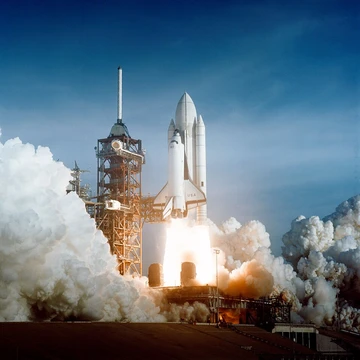
It was NASA's operational, reusable spacecraft program that ran from 1981 to 2011, serving as the United States' primary means of launching satellites, servicing orbital hardware, and providing crewed access to low Earth orbit for three decades.
How many orbiters were built and how many missions flew in total?
Five orbiters were constructed—Columbia, Challenger, Discovery, Atlantis, and Endeavour—and together they completed 135 missions over the program's lifetime.
What made the Shuttle different from earlier launch vehicles?
Unlike throwaway rockets, the Shuttle paired an orbital vehicle with reusable solid rocket boosters, so the same orbiter could fly multiple times, a design philosophy that was largely unprecedented when the program launched.
What did a typical Shuttle mission actually accomplish?
Missions generally involved deploying or retrieving satellites, running microgravity science experiments, servicing orbital hardware such as the Hubble Space Telescope, and ferrying crew and cargo to the International Space Station.
Who are some of the most recognizable figures tied to the program?
Frequently cited names include astronauts like Chris Hadfield, Sunita Williams, and Eileen Collins (the first woman to command a Shuttle), as well as the crews of the two disaster flights whose stories remain central to the program's memory.
What were the two major Shuttle disasters?
Challenger broke apart 73 seconds after liftoff on STS-51-L in January 1986, and Columbia disintegrated during reentry on February 1, 2003; in both cases all seven crew members were lost.
What was the final Shuttle mission?
STS-135, flown by Atlantis in July 2011, delivered last planned supplies to the International Space Station and marked the close of three decades of American crewed orbital flight.
Where can I see the orbiters in person today?
Discovery is displayed at the Smithsonian's Udvar-Hazy Center in Virginia, Atlantis sits at the Kennedy Space Center Visitor Complex in Florida, and Endeavour is on exhibit at the California Science Center in Los Angeles.
What's a good entry point for someone new to the missions?
A practical path is to work through the mission manifest chronologically, watch the archived live-broadcast footage on NASA's channels, and then zoom into specific flights that grab your interest, such as the Hubble deployments or the station-assembly sorties.
What is the program's lasting legacy?
It enabled the construction of the International Space Station, deployed and serviced hundreds of satellites, trained thousands of astronauts, and left a deep cultural imprint through its iconic imagery and the grief surrounding its two losses.