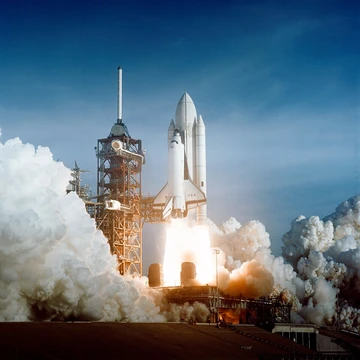
STS-2
The second flight of Columbia, testing the Canadarm and remote sensing instruments.
Last updated

NASA · Public domain
Columbia, the orbiter used, flew its second mission, designated STS-2, with Joe H. Engle and Richard H. Truly as its crew.[1] The launch occurred on November 12, 1981, and the landing on November 14, 1981, following a flight that completed 37 orbits.[1]
Key facts and history
The mission was originally intended to reboost the Skylab space station, but delays and Skylab's de-orbit in 1979 prevented this.[2] Engle and Truly were both NASA rookies, making this the first all-rookie crew since Skylab 4 and the only all-rookie crew on the space shuttle.[3] Engle had previously flown the X-15 above 80 km and earned USAF astronaut wings, but was still considered a NASA rookie.[3] The flight was shortened from five days to two days due to a fuel cell failure.[4]

A rule was put in place by NASA after STS-2 that any future shuttle commander must have already flown in space.[3][5] Even with the mission cut short, over 90 percent of its planned goals were met.[4] The external fuel tank on STS-2 was the last one on a shuttle flight to be coated with white paint.[6]
What the cited sources add
The spacefacts.de report notes that the OSTA-1 payload was the first science and applications payload scheduled by the Space Transportation System.[7] Evans' article explains that the low orbit on STS-2 was needed to permit OSTA-1 to gather data at the required resolution.[8] The same article describes that the third OMS burn was split into two halves to test turning off an OMS engine and restarting it in space.[8] Gebhardt's article states that liftoff of STS-2 marked the first time a manned spacecraft was re-flown into space.[5]
The NASA 40-year retrospective notes that modifications to the water sound suppression system were effective, with no tiles lost and only 12 damaged.[9] Malik's Space.com article reports that engineers painted the first two tanks to be on the safe side because tests were unfinished.[10]
References
- Wikipedia, "STS-2" (CC BY-SA 4.0), which cites: "STS-2", NASA}} {{PD-notice (we also read that source) en.wikipedia.org
- Wikipedia, "STS-2" (CC BY-SA 4.0), which cites: Shayler, "Skylab", Springer, 2001, p. 311 (we also read that source) en.wikipedia.org
- Wikipedia, "STS-2" (CC BY-SA 4.0), which cites: Gebhardt, "Space Shuttle Columbia: A New Beginning and Vision", www.nasaspaceflight.com, February 1, 2011 (we also read that source) en.wikipedia.org
- Wikipedia, "STS-2" (CC BY-SA 4.0), which cites: Engle, "Joe H. Engle Oral History", NASA Johnson Space Center Oral History Project, June 3, 2004}} {{PD-notice (original not read by us) en.wikipedia.org
- Gebhardt, "Space Shuttle Columbia: A New Beginning and Vision", www.nasaspaceflight.com, February 1, 2011. facts only, no text reused. nasaspaceflight.com
- Wikipedia, "STS-2" (CC BY-SA 4.0), which cites: "NASA Takes Delivery of 100th Space Shuttle External Tank", NASA, August 16, 1999 (original not read by us) en.wikipedia.org
- Becker, "Spaceflight mission report: STS-2", spacefacts.de. facts only, no text reused. spacefacts.de
- Evans, "Flying a Used Space Shuttle: 35 Years Since the Short Mission of STS-2 (Part 1)", November 12, 2016. facts only, no text reused. americaspace.com
- "STS-2", NASA}} {{PD-notice. facts only, no text reused. nasa.gov
- Malik, "Columbia's White External Fuel Tanks", Space.com, April 12, 2006. facts only, no text reused. space.com
Each numbered sentence above was checked against the source it cites before publication. Sentences citing Wikipedia adapt text from the English Wikipedia article STS-2 (contributors), used under CC BY-SA 4.0; this entry is available under the same licence. Other sources were used for facts only; no text or images are copied from them.
Sources
Compiled from Wikipedia and the sources listed below. Text from Wikipedia is available under CC BY-SA 4.0; this entry is adapted from it.
- Wikipedia: STS-2 (CC BY-SA 4.0).
Spotted an error? Know more?
Reader corrections go straight into our review queue. Suggest an edit · How this site is sourced