Kosmos 1408
Soviet ELINT satellite destroyed in a 2021 anti-satellite test.
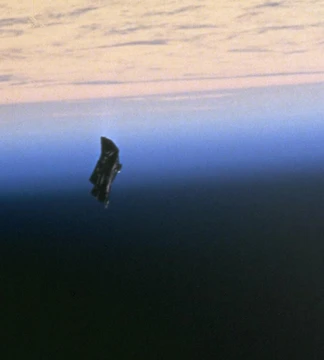
Kosmos-1408 was a Soviet electronic signals intelligence (ELINT) satellite launched on 16 September 1982. It became notable after being destroyed in a Russian anti-satellite weapon test on 15 November 2021, creating a debris cloud that threatened the International Space Station.
Quick Facts
- Mission type
- ELINT
- Mission duration
- 6 months (planned); 2 years (achieved)
- Spacecraft
- Ikar No. 39 L / 39,000 cc
- Spacecraft bus
- Tselina-D
- Manufacturer
- Yuzhnoye Design Office
- Launch mass
- 1,750 kg / 3,858 lb
- Launched
- 16 September 1982, 04:55 UTC
- Launch rocket
- Tsyklon-3
Facts from the source article.
Mission
The Soviet Yuzhnoye Design Office developed two ELINT satellite systems from 1965 to 1967: Tselina-O for broad observations and Tselina-D for detailed observations. Both systems entered service because the Soviet Ministry of Defence could not secure a decision between them. The first production Tselina-O launched in 1970, while Tselina-D faced delays. The full Tselina system became operational in 1976, and Tselina-O was abandoned in 1984, with its capabilities merged into Tselina-D.
Spacecraft
Kosmos-1408 belonged to the Tselina-D system, with a mass of about 1750 kg and a radius of roughly 2.5 m. It replaced Kosmos-1378 in a similar orbital plane. Launched on a Tsyklon-3 from Plesetsk Cosmodrome on 16 September 1982, it entered a low Earth orbit with a perigee of 645 km, apogee of 679 km, and inclination of 82.5°, with an orbital period of 97.8 minutes. Its expected lifespan was six months, but it operated for about two years. Lacking a propulsion system, it could not be de-orbited and its orbit slowly decayed.
Destruction
On 15 November 2021 at around 02:50 UTC, Kosmos-1408 was destroyed by a Russian anti-satellite weapon test. A direct-ascent A-235 Nudol anti-ballistic missile launched from Plesetsk Cosmodrome at about 02:45 UTC. The system had been tested since 2014, but this was its first satellite destruction. The Outer Space Treaty, ratified by Russia, bans some military activities in space but not anti-satellite missiles with conventional warheads. The resulting debris cloud threatened the International Space Station. The seven Expedition 66 crew members (four American, two Russian, one German) donned intravehicular activity spacesuits and took shelter in Soyuz MS-19 and SpaceX Crew-3 for quick evacuation if needed. The satellite orbited about 50 km above the ISS altitude, with debris intersecting the ISS orbit every 93 minutes. The crew sheltered only for the second and third passes based on risk assessment. No debris hit the station, but the impact risk increased fivefold for weeks and doubled long-term. In June 2022 the ISS maneuvered to avoid a piece of debris from the satellite. Several SpaceX Starlink satellites also maneuvered to reduce collision risk. On 18 January 2022, a piece of debris missed the Tsinghua Science Satellite by only 14.5 m. The US State Department reported about 1,500 trackable debris pieces and hundreds of thousands more difficult to track. Breakup was confirmed by Numerica Corporation and Slingshot Aerospace. By 16 November 2021 debris orbited at 440–520 km; by 17 November the range expanded to 300–1100 km.
More in Space Debris
Spotted an error? Know more?
Reader corrections go straight into our review queue. Suggest an edit · How this site is sourced