Agreement Concerning Cooperation in the Exploration and Use of Outer Space for Peaceful Purposes
US–USSR accord enabling Apollo–Soyuz docking and space cooperation.
Last updated
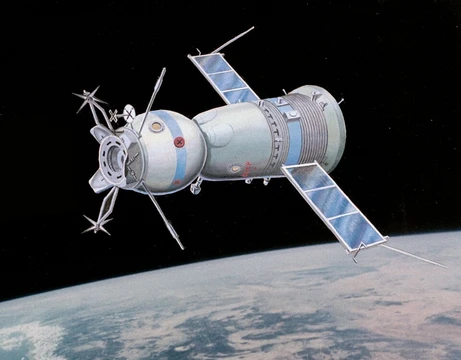
It established a legal framework for the Apollo–Soyuz Test Project and refined methods for sharing data between the two nations. Signed during the Cold War, it furthered efforts toward space cooperation between the US and the USSR.
Quick Facts
- Signatories
- US President Richard Nixon and USSR Premier A. N. Kosygin
- Signing location
- Moscow
- Signing date
- July 24, 1972
- Signing time
- 6:00 p.m. Moscow time
- Date of drafting
- Days leading up to May 24, 1972
Facts from the source article.
Background and history
American preliminary efforts were shrouded in secrecy, treated as semi-clandestine, while the Soviets had no such reservations; NASA officials learned of an upcoming meeting from the New York Times. According to The Partnership: A History of the Apollo-Soyuz Test Project, the USSR shared its drafts only a week before the Summit, causing frantic US State Department work until the middle of the night.
Key points
The Agreement enumerates areas of cooperation including exploration, space meteorology, environmental sciences, celestial bodies, and space medicine. It describes means such as delegations and meetings of scientists and specialists.
It outlines goals for developing compatible rendezvous and docking systems to enhance manned flight safety and enable joint experiments. A tentative date and method are given for docking an Apollo-type and a Soyuz-type spacecraft with crew visits. The Soviets sought clauses on communication satellites, but the US State Department could not agree as the government did not control that industry.
More in Soyuz Programme
Sources
Compiled from Wikipedia and the sources listed below. Text from Wikipedia is available under CC BY-SA 4.0; this entry is adapted from it.
- Wikipedia: Agreement Concerning Cooperation in the Exploration and Use of Outer Space for Peaceful Purposes (CC BY-SA 4.0).
Spotted an error? Know more?
Reader corrections go straight into our review queue. Suggest an edit · How this site is sourced