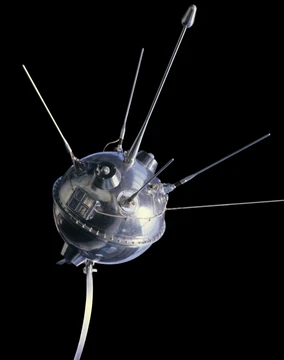
Luna 12
Soviet lunar orbiter that returned high-resolution surface photographs.
Last updated
Luna 12, also called Lunik 12, was an uncrewed Soviet lunar mission of the E-6LF series. It is notable for obtaining high-resolution photographs of the lunar surface from orbit.
Overview
Luna 12 launched toward the Moon on a Molniya-M rocket and entered lunar orbit on October 25, 1966. Its television system captured and transmitted images of the lunar surface, each containing 1,100 scan lines with a maximum resolution between 14.9 and 19.8 meters. The first pictures were sent back on October 27, 1966, though the total number of photographs taken is unknown. The Soviet press released initial images on October 29, showing the Sea of Rains and Aristarchus crater, with resolution up to 15 to 20 meters.
Onboard, film was automatically developed, fixed, dried, and scanned for transmission. No additional photos were ever made public. After completing its primary imaging task, the spacecraft was placed into a spin-stabilized roll to fulfill its scientific objectives, which it did successfully. Radio signals from Luna 12 ended on January 19, 1967, after 602 lunar orbits and 302 radio transmissions.
It was the first Soviet probe designed to prevent signal interception by Jodrell Bank Observatory; when within the observatory’s view, it switched between two frequencies, a pattern the observatory could not track.
More in Soviet Missions to the Moon
Sources
Compiled from Wikipedia and the sources listed below. Text from Wikipedia is available under CC BY-SA 4.0; this entry is adapted from it.
- Wikipedia: Luna 12 (CC BY-SA 4.0).
Spotted an error? Know more?
Reader corrections go straight into our review queue. Suggest an edit · How this site is sourced