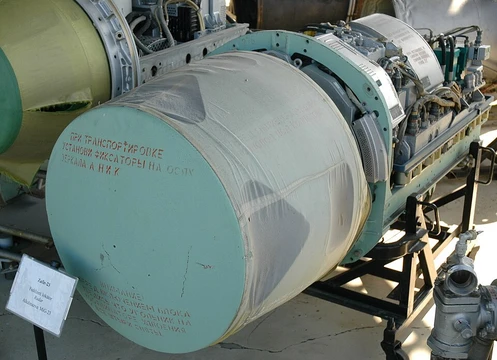
P-18 radar
Soviet VHF early warning radar with counter-stealth capability.
Last updated
The P-18 or 1RL131 Terek, known in the West by the NATO reporting name Spoon Rest D, is a 2D VHF radar developed and operated by the former Soviet Union. It entered service in 1970 as a development of the earlier P-12 radar.
Development
The P-18 early warning radar was developed by the SKB Design Bureau, a division of State Plant No.197 named after V. I. Lenin, which had also developed the preceding P-12 radar. The P-18 was accepted into service in 1970 after the program's successful completion. In 1979, a new secondary IFF radar, the 1L22 Parol, entered service to complement the P-18; unlike the earlier NRS-12 (NATO Score Board), the new interrogator was carried on a separate truck. The P-18 remains in service and has been widely exported, with many companies offering upgrade packages.
NNIIRT, the successor to the original design bureau, offers an upgrade that includes a solid state transmitter and receiver, automatic jammer suppression equipment, and PC-based signal processing, test, and interface equipment. Upgraded variants are referred to as P-18M, P-18-1, or P-18-2 depending on manufacturer, modification, and nationality. The P-18 was superseded in 1984 by the 1L13 Nebo VHF surveillance radar. The Russian-Belarusian company Defense Systems provides upgrades, and the Czech company Retia developed its own modernisation called ReVEAL, which is solid state, digitized, fitted with an upgraded IFF system, and repackaged into a standard container.
Description
The P-18 shares many similarities with the earlier P-12NA and is mounted on two Ural-4320 truck chassis. It features improvements over the P-12 including increased performance, precision, and reliability. The radar was designed to operate independently or as part of a C3 system directing SAM and aircraft to hostile targets, and its truck-mounted design provides high mobility.
The single antenna, composed of sixteen Yagi antennas mounted in two sets of eight, handles both transmission and reception. The antenna is mounted on the transport truck and includes a mechanism to alter its height and elevation during operation. Azimuth is scanned mechanically at 10 r.p.m. The original P-18 used three indicators: two plan position indicators and a backup A-scope.
It features automatic frequency control with four pre-set operating frequencies, moving target indicator to eliminate passive clutter and active jamming, and could display tracks from a paired radar. The original transmitter used a coaxial cavity resonator, the receiver was vacuum tube with a transistor preamplifier, and the duplexer used vacuum tube and pin diode components. A secondary IFF radar, either the NRS-12 or the later 1L22 Parol, is generally used with the P-18.
Variants
Several modifications and variants of the P-18 extend its original capabilities. The P-18PL is a modernized Polish road-mobile, long-range, three-dimensional (3D), VHF early warning radar using active electronically scanned array (AESA) technology. It is noted for enhanced anti-stealth capability and is somewhat similar to the Russian Nebo-SVU radar. Its VHF (meter band) operation enhances detection of targets using contemporary stealth techniques, which are optimized against microwave-band radars.
The meter band also serves as an electronic counter-countermeasure, as jammers and anti-radiation missiles typically operate above 1 GHz. The VHF band minimizes atmospheric attenuation and simplifies construction. The P-18PL can perform long-range preliminary target detection, target designation for air defense systems, defense against ballistic and hypersonic missiles, airspace control, and support for own forces.
Its antenna can rotate for 360° azimuth coverage or be directed at a 90° sector for electronic scanning. It has multiple configurable modes of operation. Instrumented range is 900 km with altitudes up to 160 km, or 600 km with altitudes up to 120 km depending on parameters.
During testing, targets with RCS as low as 0.0001 m² were detected. Precision is 30 m in range and 0.3° in azimuth, achieved through advanced signal processing. It includes an IFF system (Mark XIIA Mode 5 and civilian Mode S) with a long-range interrogator, communication systems for information exchange, and jammer detection, parametrization, and radiolocation. It has redundant power generators and can operate from external industrial electrical connections.
Operators
The P-18 was operated by the Soviet Union from 1970 and, after becoming obsolete, was passed down to successor states after the fall of the Soviet Union. It continues to serve in many client and third world states that received it by export. Many P-18s have been upgraded and remain in military and air traffic control roles worldwide. A P-18 was photographically confirmed active at Bagram AB in April 1992 after Jamiat-e Islami mujahideen overran the base, and it probably continued operating for some time before being destroyed during the civil war in the 1990s.
It was used by the first Flying Rhino NATO Exercise in 1999. In Finland it is known as Maalinosoitustutka 2, used for anti-aircraft artillery and S-125 Neva/Pechora batteries. A Hungarian example upgraded by HM Arzenel from 2000 was displayed at the Kecskemét 2007 Air and Military Show.
The P-18M is considered obsolete and is being replaced by other radars like Rohini. In Bulgaria it was upgraded by Aerotechnica MLT. In Croatia it is locally known as Laura. The radar was passed to successor states.
Did You Know?
- The presence of a P-18 radar in Yugoslavia during the Kosovo War contributed to the loss of a US F-117 Nighthawk.
More in Soviet Military Radars
Sources
Compiled from Wikipedia and the sources listed below. Text from Wikipedia is available under CC BY-SA 4.0; this entry is adapted from it.
- Wikipedia: P-18 radar (CC BY-SA 4.0).
Spotted an error? Know more?
Reader corrections go straight into our review queue. Suggest an edit · How this site is sourced