Frequently Asked Questions
The most-asked questions about soft corals and leathers.
What are soft corals and leathers?
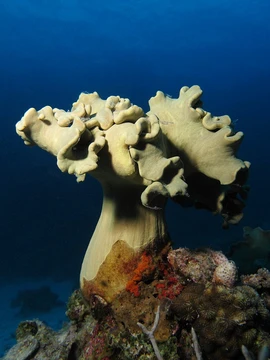
Soft corals and leathers are colonial marine invertebrates whose bodies are made of flexible, fleshy tissue rather than a rigid calcium skeleton. They belong to the broader group Alcyonacea (leathers) or the order Scleractinia (true soft corals) and are prized in reef aquariums for their vivid colors and relatively forgiving care.
What's the difference between a 'soft coral' and a 'leather'?
In hobbyist parlance, 'leather' refers to members of the family Nephtheidae—Sarcophyton, Sinularia, Xenia, and relatives—while 'soft coral' usually means Scleractinia species like Dendronephthya or Euphyllia. Both lack a hard plate, but they differ in polyp anatomy, growth form, and chemical defenses.
Where do they come from in the wild?
Most popular aquarium species are collected from Indo-Pacific reef systems, particularly Indonesia, the Philippines, and surrounding island chains, where they attach to rocky outcrops, overhangs, or sandy slopes. Depths range from a few meters to well past 40 m depending on the species.
What lighting and flow do they need in a reef tank?
Leathers and soft corals generally prefer moderate-to-high LED or metal-halide light paired with gentle to moderate water movement; they are more sensitive to harsh flow than stony corals. Too much light or turbulent current can trigger tissue retraction or bleaching.
Do I have to feed them?
They are primarily filter feeders that capture plankton and dissolved organics from the water column, so supplemental feeding is optional. Many keepers offer a small dose of frozen brine shrimp or liquid coral food once or twice weekly to encourage growth.
Are they dangerous to handle?
Their stinging cells are mild to humans—more of a skin irritant than a serious hazard. However, several Sarcophyton and Sinularia species secrete potent allelopathic chemicals (including palytoxin-like compounds) that can cause pain or worse if touched or ingested, so rinsing hands after handling is wise.
How do I propagate a leather or soft coral?
The standard method is fragmentation: snip a healthy 3–5 cm piece from the colony with clean scissors and secure it to a rock or plug using marine-safe epoxy or a zip-tie. Some species also spread naturally through broken fragments drifting and settling on new substrate.
What's the most common problem new keepers face?
Tissue melting or retraction tops the list, typically triggered by poor water quality, excessive light, insufficient flow, or chemical aggression from a neighboring coral. In crowded tanks, one leather's allelopathic secretion can cause a nearby coral to lose tissue within days.
Can they coexist with fish and other invertebrates?
They are generally peaceful toward reef fish and most invertebrates, making them a good fit for mixed tanks. The main compatibility concern is coral-to-coral: species like Xenia or Sinularia can chemically suppress adjacent LPS or SPS colonies, so adequate spacing is important.
Which species should a beginner start with?
Xenia (pulsing leather), Sinularia (tooth leather), and Sarcophyton (bubble-tip) are widely recommended entry points because they tolerate a broader range of conditions and are less chemically aggressive. Dendronephthya (bird's-nest coral) is another visually striking soft coral that is straightforward to maintain for newcomers.