Frequently Asked Questions
The most-asked questions about soft corals and leathers, part 2.
What's the actual taxonomic difference between a 'soft coral' and a 'leather'?
Both fall under the order Scleractinia, but 'leathers' typically refers to the genus Sarcophyton (and close relatives like Siderastrea) with thick, leathery polyps, while 'soft corals' is a broader colloquial umbrella covering Sinularia, Xenia, Dendronephthya, and other genera with more delicate, branching, or feathery tissue structures.
Which genera do hobbyists most commonly keep and trade?
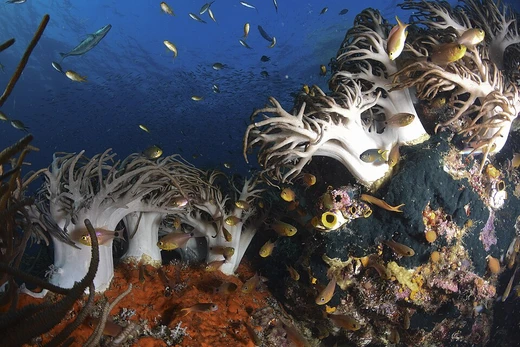
Sarcophyton (often called 'leathers'), Sinularia (branching leathers), Xenia (pulsing corals), Dendronephthya (sea plumes), and Euphyllia (torch corals) dominate the trade, with Sarcophyton glaucum, Sinularia flexibilis, and Xenia sp. being among the most frequently listed species.
How should I feed soft corals and leathers?
They are more heterotrophic than stony corals and benefit from regular targeted feeding with small pieces of frozen mysis, brine shrimp, or commercial gel foods every few days. A gentle misting of liquid reef fertilizer or a fine spray of micro-particles over the polyps also supplements their nutrition.
Why is my leather or soft coral 'melting,' and how do I stop it?
Melting is usually triggered by sudden parameter shifts—especially a drop in temperature, a spike in nitrate, aggressive stinging from a neighboring coral, or a recent transport shock. Stabilize water chemistry, move the coral to lower flow temporarily, and trim any dead tissue to prevent bacterial infection while it recovers.
Can I fragment and propagate soft corals and leathers myself?
Yes—most Sarcophyton and Sinularia pieces heal well when cut with a clean blade, dipped in a mild antiseptic like iodine or hydrogen peroxide, and glued to a rock or plug. Dendronephthya and Xenia also take fragments, though their healing period is longer and they are more sensitive to handling.
What light and flow levels do they actually need?
Most leathers and soft corals thrive under moderate to high LED intensity (roughly 10,000–20,000 lux at the colony) but are far more tolerant of dimmer conditions than SPS corals. Flow should be moderate and indirect—strong, direct current can shred delicate Sinularia branches or flatten Xenia polyps.
What are the most common predators and pests I should watch for?
Nudibranchs (especially Chromodoris and Phyllidia species), butterflyfish, and certain zoanthid polyps are the primary biological threats. Parasitic worms and bacterial infections are also frequent, particularly after transport or when water quality dips.
How long does acclimation take, and what's the safest method?
A standard drip acclimation of 30–60 minutes for water temperature and pH, followed by a 10–15 minute float of the bag in the display tank, is the baseline. For sensitive pieces like Dendronephthya, extending the drip to two hours and adding a small dose of coral-safe stress reducer can reduce post-acclimation shrinkage.
What water parameters should I target specifically for leathers and soft corals?
Aim for 76–80 °F (24–27 °C), salinity 1.024–1.026, pH 8.0–8.4, alkalinity 7–9 dKH, calcium 400–450 ppm, and magnesium 1300–1400 ppm. They are generally more forgiving than SPS corals but are notably sensitive to rapid temperature swings and elevated nitrate above 5 ppm.
How do I tell Xenia apart from other 'pulsing' corals like Sarcophyton or Sinularia?
Xenia has small, uniform, finger-like polyps that contract and expand in a synchronized, wave-like rhythm, and the tissue is usually smooth and rubbery without the thick, fleshy bumps of Sarcophyton or the branching, tentacle-like structure of Sinularia. Under a magnifier, Xenia polyps lack the visible nematocyst clusters that characterize true leathers.