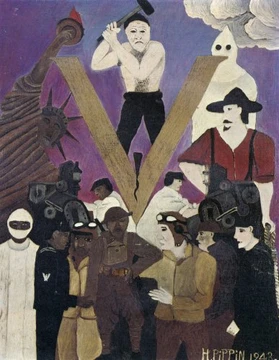
Stereotype
Last updated
In social psychology, a generalized belief about a particular category of people is called a stereotype, and it involves an expectation about every person in that group.[1] By allowing a perceiver to use previously stored knowledge instead of processing new information, stereotypes make information processing easier.[2] Stereotypes are frequently faulty and resist new information; studies on their accuracy have produced mixed findings, with national-origin and astrological-sign stereotypes found inaccurate but gender stereotypes more reflective of reality.[2]
Quick Facts
- Field
- Social psychology
Facts from the source article.
Key facts and history
Explicit stereotypes operate through deliberate reasoning, not automatic association, as shown in research on age stereotypes.[3] Implicit stereotypes are automatic, involuntary associations that people make between a social group and an attribute, lying outside conscious awareness.[4] Stereotypes are considered the cognitive component of intergroup attitudes, distinct from prejudice (affective) and discrimination (behavioral).[5] Early theories assumed stereotypes of outgroups reflected uniform antipathy, as in Katz and Braly's 1933 study on ethnic stereotypes.[6]
They also serve social functions, such as explaining events, justifying ingroup actions, and positively differentiating the ingroup from outgroups.[7][8][9] Stereotypes can form through illusory correlation, where observers overestimate the co-occurrence of two infrequent events.[10][11] Shared stereotypes may result from common environments, socialization, or intergroup relations that motivate group members to behave in certain ways.[12]
What the cited sources add
The Implicit Association Test measures the strength of associations between concepts and evaluations or stereotypes.[13] Explicit and implicit stereotypes may be similar or different for a person, depending on various factors.[13] An implicit measure of stereotypes assesses associations indirectly, typically using reaction times.[13] The Project Implicit website makes anonymized data publicly available for scientists and educators to study attitudes and stereotypes.[13]
The internet's abundance of images of naked or barely dressed women skews AI training data toward sexist stereotypes.[14] Men generated by AI were typically portrayed as strong, assertive, or associated with careers and dominance.[15] Without any prompting, an AI model sexualized women by generating them in skimpy clothes, with larger chests, and in suggestive positions.[14][15]
References
- Wikipedia, "Stereotype" (CC BY-SA 4.0), which cites: Cardwell, "Dictionary of Psychology", Fitzroy Dearborn, 1999 (original not read by us) en.wikipedia.org
- Wikipedia, "Stereotype" (CC BY-SA 4.0), which cites: Meyer, "Intuition: Its Powers and Perils", Yale University Press, 2008, p. 114–115 (original not read by us) en.wikipedia.org
- Wikipedia, "Stereotype" (CC BY-SA 4.0), which cites: Huang, "Implicit and Explicit Age Stereotypes Assessed in the Same Contexts are Still Independent", Experimental Aging Research, 2023-01-01, p. 41–57 (original not read by us) en.wikipedia.org
- Wikipedia, "Stereotype" (CC BY-SA 4.0), which cites: "Frequently Asked Questions", Implicit.Harvard.edu; Hinton, "Implicit stereotypes and the predictive brain: Cognition and culture in "biased" person perception", Palgrave Communications, 1 September 2017, p. 1–9 (we also read that source) en.wikipedia.org
- Wikipedia, "Stereotype" (CC BY-SA 4.0), which cites: Vega, "Working while brown: What discrimination looks like now", CNNMoney; Fiske, "The Handbook of Social Psychology", McGraw-Hill, 1998, p. 357; Denmark, "The Corsini Encyclopedia of Psychology", John Wiley, 2010, p. 1277; Katz, "Racial prejudice and racial stereotypes", The Journal of Abnormal and Social Psychology, 1935, p. 175–193; Oakes, "Stereotyping and Social Reality", Blackwell, 1994; Fiske, "The Handbook of Social Psychology", McGraw-Hill, 1998, p. 357; Denmark, "The Corsini Encyclopedia of Psychology", John Wiley, 2010, p. 1277; D en.wikipedia.org
- Wikipedia, "Stereotype" (CC BY-SA 4.0), which cites: Fiske, "A Model of (Often Mixed) Stereotype Content: Competence and Warmth Respectively Follow From Perceived Status and Competition", Journal of Personality and Social Psychology, 2002, p. 878–902; Cuddy, "Ageism: Stereotyping and Prejudice against Older Persons", MIT Press, 2002, p. 7–8; Operario, "Blackwell Handbook of Social Psychology: Intergroup Processes", Blackwell, 2003, p. 22–44 (original not read by us) en.wikipedia.org
- Wikipedia, "Stereotype" (CC BY-SA 4.0), which cites: Haslam, "Stereotypes as Explanations", 2002, p. 157–185 (we also read that source) en.wikipedia.org
- Wikipedia, "Stereotype" (CC BY-SA 4.0), which cites: Tajfel, "Intergroup behaviour", Blackwell, 1981, p. 144–167; Haslam, "Stereotypes as Explanations", 2002, p. 157–185; Tajfel, "Intergroup behaviour", Blackwell, 1981, p. 144–167 (we also read that source) en.wikipedia.org
- Wikipedia, "Stereotype" (CC BY-SA 4.0), which cites: Tajfel, "Intergroup behaviour", Blackwell, 1981, p. 144–167; Allport, "The Nature of Prejudice", Addison-Wesley, 1954, p. 189; Haslam, "Stereotypes as Explanations", 2002, p. 157–185; Tajfel, "Intergroup behaviour", Blackwell, 1981, p. 144–167 (we also read that source) en.wikipedia.org
- Wikipedia, "Stereotype" (CC BY-SA 4.0), which cites: McGarty, "Stereotypes as explanations: The formation of meaningful beliefs about social groups", Cambridge University Press, 2002, p. 1–15; Mullen, "Distinctiveness-based illusory correlations and stereotyping: A meta-analytic integration", British Journal of Social Psychology, 1990, p. 11–28; Meiser, "Information Sampling and Adaptive Cognition", Cambridge University Press, 2006, p. 183–209 (original not read by us) en.wikipedia.org
- Wikipedia, "Stereotype" (CC BY-SA 4.0), which cites: Hamilton, "Illusory correlation in interpersonal perception: A cognitive basis of stereotypic judgments", Journal of Experimental Social Psychology, 1976, p. 392–407; Berndsen, "Stereotypes as explanations: The formation of meaningful beliefs about social groups", Cambridge University Press, 2002, p. 90–110; Stroessner, "Cognitive Social Psychology: The Princeton Symposium on the Legacy and Future of Social Cognition", Lawrence Erlbaum Associates, 2001, p. 247–259 (original not read by us) en.wikipedia.org
- Wikipedia, "Stereotype" (CC BY-SA 4.0), which cites: McGarty, "Stereotypes as explanations: The formation of meaningful beliefs about social groups", Cambridge University Press, 2002, p. 1–15 (original not read by us) en.wikipedia.org
- "Frequently Asked Questions", Implicit.Harvard.edu. implicit.harvard.edu
- "How it feels to be sexually objectified by an AI", MIT Technology Review. technologyreview.com
- Wikipedia, "Stereotype" (CC BY-SA 4.0), which cites: "How it feels to be sexually objectified by an AI", MIT Technology Review (we also read that source) en.wikipedia.org
Each numbered sentence above was checked against the source it cites before publication. Sentences citing Wikipedia adapt text from the English Wikipedia article Stereotype (contributors), used under CC BY-SA 4.0; this entry is available under the same licence. Other sources were used for facts only.
More in Social Identity & Prejudice
Sources
Compiled from Wikipedia and the sources listed below. Text from Wikipedia is available under CC BY-SA 4.0; this entry is adapted from it.
- Wikipedia: Stereotype (CC BY-SA 4.0).
Spotted an error? Know more?
Reader corrections go straight into our review queue. Suggest an edit · How this site is sourced