Frequently Asked Questions
The most-asked questions about snappers and grunts.
What exactly are snappers and grunts?
Snappers (family Lutjanidae) and grunts (family Haemulidae) are two closely related groups of reef-dwelling fish found in tropical and subtropical seas worldwide. They are among the most recognizable and ecologically important members of coral reef and rocky-reef communities.
How do you tell a snapper apart from a grunt?
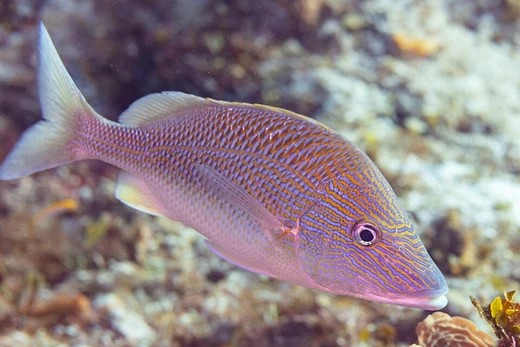
Snappers tend to be larger, more strongly built, and predominantly carnivorous, while grunts are usually smaller, more laterally compressed, and feed on algae, small invertebrates, and detritus. Both groups share a similar general body shape and a single dorsal fin, but grunts often display brighter, more patterned coloration.
Where do snappers and grunts live?
They inhabit coral reefs, rocky outcrops, mangrove edges, and seagrass beds from the Atlantic (including the Caribbean and Gulf of Mexico) through the Pacific and Indian Oceans. Depth ranges span from the shallow intertidal zone down to roughly 200 m, with many species shifting between shallow and deeper habitats as they age.
Which species are the 'headliners' a newcomer should know first?
In the Atlantic and Caribbean, the Mutton Snapper, Queen Snapper, and Red Snapper are the flagship snappers, while the French Grunt, Pinfish, and Grunt are the most commonly encountered grunts. In the Indo-Pacific, the Coral Trout, Giant Snapper, and various Pseudupeneus grunts round out the most famous names.
Where should a new fan start exploring this group?
Begin with the Caribbean/Atlantic species, since they are the most widely documented in diving guides, fisheries literature, and aquarium hobbyist communities. From there, branch into Indo-Pacific species and the taxonomic literature that repeatedly reshuffles genera within Lutjanidae and Haemulidae.
What are some key biological facts that surprise people?
Many snappers are protandrous hermaphrodites, meaning individuals change sex from male to female as they mature. Their coloration can shift dramatically with mood, time of day, and reproductive state, and several species aggregate in huge spawning schools over reef slopes at night.
Why are snappers and grunts important to humans?
They form a major component of both commercial and recreational fisheries across the tropics, providing protein and significant economic value. At the same time, several species—especially large-bodied snappers like the Queen Snapper and Giant Snapper—are vulnerable to overfishing and are subject to size limits and catch quotas.
Are they dangerous to divers or swimmers?
They are generally non-aggressive toward humans and will usually flee or freeze rather than attack. However, larger predatory snappers have sharp, canine-like teeth, so handling them on a dock or in a boat requires care to avoid bites.
What are some notable conservation or research moments?
The 2010s saw renewed taxonomic revisions that split or merged several snapper genera based on genetic data, reshuffling species names in fisheries reports. In the Caribbean, the Mutton Snapper was added to NOAA's overfished list, prompting stricter bag limits and spawning-season closures in several jurisdictions.
Can you keep snappers or grunts in a home aquarium?
Smaller grunts like the Pinfish or French Grunt are popular in large reef tanks because of their vivid colors and manageable size. Most snappers grow too large and become too aggressive for typical home setups, though a few smaller species are successfully kept in 300-gallon-plus systems by experienced hobbyists.