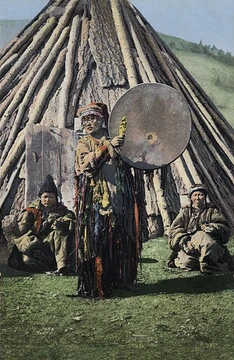
Regional forms of shamanism
Shamanism varies widely across cultures and regions worldwide.
Shamanism is a religious practice found in various cultures and religions worldwide, taking on many different forms that vary greatly by region and culture. These forms are shaped by the distinct histories of their practitioners. The diversity of shamanic traditions spans continents and reflects local beliefs and social structures.
Quick Facts
- Hmong shamanic practice age
- 5,000 years
Facts from the source article.
Did You Know?
- In Papua New Guinea, indigenous tribes believe illness and calamity are caused by dark spirits called masalai, which cling to a person's body and poison them.
- Australian aboriginal shamans, known as clever men and clever women or kadji, use maban or mabain, the material believed to give them their magical powers.
- In Zulu and congeneric languages, the term sangoma is effectively equivalent to shaman; sangomas are highly revered in their society.
Eurasia
Wuism, also known as wu xi zongjiao, describes the shamanic traditions found in China, with close ties to ancient Neolithic cultures like the Hongshan culture. These practices are woven into Chinese folk religion. Various ethnic minorities within China, such as the Manchu, Mongol, Tibetan, Miao, Naxi, and Pumi peoples, continue to practice shamanism. The Hmong people, who originally come from Central China, still follow their own shamanic tradition called Ua Neeb.
For the Hmong, becoming a shaman is a calling. Their main job is to create balance for individuals, families, and the community with their surroundings, often by entering a trance and performing rituals. Hmong belief holds that everything in the world has one or more souls, all of which are equal and can be exchanged. Animal sacrifice is a key part of this belief system.
It is seen as a necessary act to borrow an animal's soul to heal a person's sickness or to prevent their soul from being taken by a wild spirit for a year. During the Hmong New Year, a shaman conducts a special ceremony to send the animal's soul to the spirit world. This soul is then reborn as a higher animal, possibly joining a god's household and living a comfortable life free from suffering. Being sacrificed is therefore considered a great honor for the animal.
In southeast Guizhou, before a sacred cockfight, the Hmong cover a rooster with red cloth and raise it as an offering to Heaven and Earth. Hmong shamans also use sacred texts, known as khawv koob, to treat physical illnesses.
Circumpolar shamanism
Shamanic practices and beliefs have been documented across the vast territory inhabited by Eskimo groups, which stretches from eastern Siberia through Alaska and Northern Canada to Greenland. A key feature of shamanism in these cultures is the role of the mediator, a person believed capable of contacting spirits. In English-language publications, the term "shaman" is applied to these figures, and among Eurasian Eskimos, the word alignalghi is used.
The belief system establishes specific connections between the living, the souls of hunted animals, and the souls of the dead, with several groups exhibiting soul dualism. Unlike many other shamanic traditions, becoming an Eskimo shaman is typically a deliberate choice rather than a calling forced by spirits. While there is considerable diversity across Eskimo groups, certain similarities exist. For instance, the shamanistic seances of Siberian Yupik and Sireniki groups resemble those of Greenland Inuit, despite the great distance between them.
A specialized shaman’s language, used primarily to communicate with spirits, is documented among several groups. The Ungazighmiit, a Siberian Yupik group, also employed a special allegorical form of speech.
Americas
The term "shaman" is not used by Native American or First Nations peoples to describe their own spiritual leaders, who are instead known by names from their respective languages, such as "Badi" in Otomi culture. These traditions have often been misunderstood by outsiders, with accounts frequently colored by romanticized or racist "noble savage" stereotypes. Not every Indigenous community has a designated individual who acts as an intermediary with the spirit world.
Where such roles do exist, similarities in beliefs and practices can sometimes be traced to close cultural ties, shared geographic regions, or the forced merging of distinct nations on reservations under colonial policies, which can create a false impression of greater historical unity. European colonization brought suppression of these traditional religions in favor of Christianity. From the colonial period until the American Indian Religious Freedom Act of 1978, practicing Indigenous ceremonies was illegal.
Many traditions survived by going underground or blending with Christian elements. Additionally, thousands of Native American and First Nations children were removed from their communities and placed in residential or boarding schools, a policy designed to erase tribal languages, cultures, and beliefs. Later Canadian laws from 1982 onward have aimed to reverse some of this cultural damage.
Neoshamanism
In modern occult and esoteric groups, some people are trying to create a new version of shamanism. This often builds on core shamanism, a system created by Michael Harner that uses drumming, dance, and his own take on various indigenous religions. Harner has been criticized for pulling practices from different cultures without their original context. Some neoshamans use entheogens in rituals and follow chaos magic ideas, while others, like Jan Fries, have developed their own approaches.
Eurasian neoshamanic traditions look to the real or imagined practices of ancient Eurasia, where Christian authorities suppressed many mystical beliefs. Some practitioners want to follow systems tied to their own ancestry. Anthropologists note that this neoshamanism can give extra attention to indigenous American traditions, especially since many pagan or heathen practitioners use specific names like völva or seidkona instead of calling themselves shamans.
Many spiritual seekers go to Peru to work with ayahuasqueros, shamans who use ayahuasca ritually. Participants often report meeting spirits and receiving revelations. New Age therapies also use shamanistic techniques involving enactment and exploring other realities.
More in Shamanism
Spotted an error? Know more?
Reader corrections go straight into our review queue. Suggest an edit · How this site is sourced