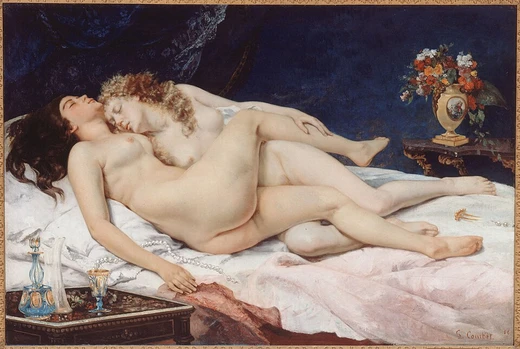
One-night stand
Last updated
A single sexual event where participants do not anticipate ongoing relations defines a one-night stand.[1]
Quick Facts
- Earliest recorded sexual use
- 1930s
Facts from the source article.
Key facts and history
A 2026 international study of 1,044 people found that 55% had met their sexual partner the same day.[2] The prevalence of one-night stands has been abetted by the advent of online dating apps such as Tinder and Grindr.[3] Originally, the phrase described a performer or theater group giving just one show at a location before traveling elsewhere.[1] Since the 1930s, the term has been documented with a sexual meaning.[1]
One-night stands happen in many different situations, often at nightlife spots and social events.[2] Across every age group studied, men reported having one-night stands more often than women did.[4]
What the cited sources add
Ben-Zeév also reported that Fisher argued men were three times more likely to want to turn a one-night stand into a relationship.[5] The Psychology Today review noted that after booty-call sex, individuals were more likely to leave immediately, as opposed to one-night stands where individuals stayed longer.[5] A Guardian article describes partners role-playing as strangers meeting in a hotel bar for a one-night stand.[6]
References
- Wikipedia, "One-night stand" (CC BY-SA 4.0), which cites: Wentland, "Casual sexual relationships: Identifying definitions for one night stands, booty calls, fuck buddies, and friends with benefits", The Canadian Journal of Human Sexuality, 2014, p. 167–177; "One-night stand", Dictionary.com; "One-night stand", Dictionary.com; Jeffrey S. Turner, American Families in Crisis: A Reference Handbook (2009), p. 47.; de Jong, "Encyclopedia of Mental Health", Elsevier, 2016, p. 25–32 (we also read that source) en.wikipedia.org
- Wikipedia, "One-night stand" (CC BY-SA 4.0), which cites: Sagioglou, "The Gender Gap in One-Night Stand Regret: Evidence from Heterosexual and Same-Sex Encounters", Archives of Sexual Behavior, 2026, p. 589–612 (original not read by us) en.wikipedia.org
- Wikipedia, "One-night stand" (CC BY-SA 4.0), which cites: Laura Palmer, "Dating in the Age of Tinder: Swiping for Love?", in Julia Carter and Lorena Arocha, eds., Romantic Relationships in a Time of 'Cold Intimacies (2 (original not read by us) en.wikipedia.org
- Wikipedia, "One-night stand" (CC BY-SA 4.0), which cites: Bergström, "Couples, one-night stands, sexfriends: The varied intimate lives of the under-30s", Population & Societies, 2024, p. 1–4; Bergström, "Couples, one-night stands, sexfriends: The varied intimate lives of the under-30s", Population & Societies, 2024, p. 1–4; Bergström, "Couples, one-night stands, sexfriends: The varied intimate lives of the under-30s", Population & Societies, 2024, p. 1–4 (original not read by us) en.wikipedia.org
- Aaron Ben-Zeév, "How One-Night Stands Turn Into Something More", Psychology Today, June 7, 2022. facts only, no text reused. psychologytoday.com
- Drake, "This is how we do it: 'Gearing up for sex requires stepping out of our everyday personas'", The Guardian, 22 July 2023. facts only, no text reused. theguardian.com
Each numbered sentence above was checked against the source it cites before publication. Sentences citing Wikipedia adapt text from the English Wikipedia article One-night stand (contributors), used under CC BY-SA 4.0; this entry is available under the same licence. Other sources were used for facts only; no text or images are copied from them.
More in Sexual Practices & Identities
Sources
Compiled from Wikipedia and the sources listed below. Text from Wikipedia is available under CC BY-SA 4.0; this entry is adapted from it.
- Wikipedia: One-night stand (CC BY-SA 4.0).
Spotted an error? Know more?
Reader corrections go straight into our review queue. Suggest an edit · How this site is sourced