Ingjald
Semi-legendary Yngling king of Sweden, son of Anund.
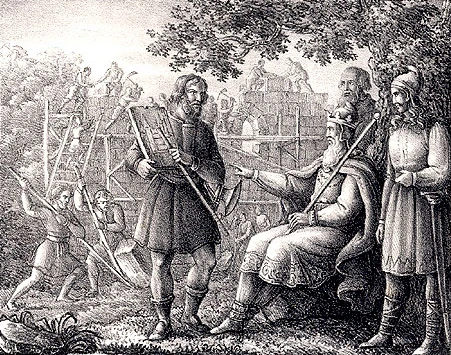
Ingjald illråde, also known as Ingjaldr hinn illráði, was a semi-legendary Swedish king of the House of Ynglings. He was the son and successor of King Anund, and the father and predecessor of King Olof Trätälja. His historicity, like that of many 5th-7th century Yngling kings, is contested.
Quick Facts
- Predecessor
- Anund
- Successor
- Ivar Vidfamne
- Spouse
- Gauthild Algautsdóttir
- Issue
- Olof Trätälja
- Åsa
- Sigurd Ring
- House
- House of Yngling
- House type
- Dynasty
- Place of death
- Raening
Facts from the source article.
Ynglinga saga
Ingjald became king of Sweden after his father Anund died. The kings at Uppsala were the leading rulers among the provinces, holding supreme authority since Odin’s time and after Sweden was divided between Erik and Alrik. Their descendants spread, cleared land, and founded new settlements, eventually creating many petty kings. Ingjald’s father Anund had arranged his marriage to Gauthild, daughter of the Geatish king Algaut, son of Gautrek the Mild and grandson of Gaut.
Gautrek agreed, thinking Ingjald would have his father’s temperament. Gauthild’s maternal grandfather was Olof the Sharp-sighted, king of Närke. Earlier, when Ingjald was six, he and Alf, son of viceroy Ingvar of Fjärdhundraland, played during the midwinter sacrifices at Uppsala. Ingjald was weaker and nearly cried.
His foster-brother Gautvid told Svipdag the Blind, viceroy of Tiundaland, about this lack of strength. Svipdag gave Ingjald a roasted wolf’s heart to eat the next day. After that, Ingjald became ferocious, with a bad disposition and breath. To celebrate his own rise to power, Ingjald built a grand hall as large as the one in Uppsala, called the hall of the seven kings, with seven high seats.
He invited kings, jarls, and other important men to a feast. King Algaut of West Götaland, King Ingvar with his sons Agnar and Alf, King Sporsnjall of Nerike, and King Sigvat of Attundaland came. King Granmar of Södermanland did not attend. The kings filled six of the seven seats, leaving one empty. All prominent people had seats, but Ingjald sent his own court to his old hall in Uppsala.
Archaeological evidence
Rällinge, a hill fort in Raä Helgarö 32:1, Helgarö parish, Södermanland, has small ramparts near Lake Mälaren and is thought to be a misinterpretation of the saga hill fort Ræning. According to legends, Ræning was where Ingjald and his daughter Åsa met their ends at the hands of Ivar Vidfamne. Thermoluminescence dating has found evidence of a burning at Rällinge from the supposed time of Ingjald's demise (600-650 A.D.), and the dating does not contradict assumptions about where and when he was burned to death.
More in Semi-legendary Kings of Sweden
Spotted an error? Know more?
Reader corrections go straight into our review queue. Suggest an edit · How this site is sourced