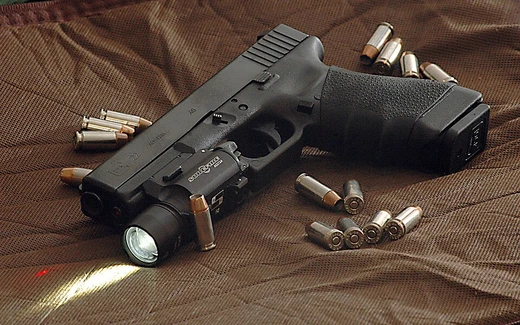
Tarn pistol
Experimental Polish-exile blowback pistol from wartime Britain.
The Tarn pistol was an experimental semi-automatic firearm developed in Britain near the end of the Second World War by Polish exiles. Only a small number of prototypes were made. It was designed primarily for the 9×19mm Parabellum cartridge, though a smaller version in 7.65mm (.32 ACP) also existed.
Prototype examples were built by the Swift Rifle Company, a firm that normally produced training rifles and military training aids. The pistol’s design is usually credited to Captain Zygmunt Stanisław de Lubowicz-Bakanowski, a Polish exile and former officer of the 18th Pomeranian Uhlan Regiment who worked with the company. However, records from the Polish Army Museum in Warsaw suggest the weapon was actually designed by Sergeant Major Teofil Tarnowski of the Polish Armed Forces in the West. Surviving pistols have “TE-TARN” or “TARN” stamped on the left side of the slide, which is thought to refer to Tarnowski. It is not known whether Tarnowski worked alone or with Bakanowski.
The Tarn used a simple blowback system. Because it had no locking mechanism and fired a relatively powerful 9mm round, the pistol required heavy moving parts and an unusually strong return spring. When the gun was in battery, the return spring was compressed by about 102 mm (4 inches). The slide’s mass and the spring’s strength were needed to delay the breech’s rearward movement. Earlier attempts to pair 9×19mm ammunition with simple blowback, such as the Walther Model 6 and the Dreyse M1910, had generally not been very successful.
British evaluators found that most internal parts—the trigger, disconnector, and striker—were conventional. The magazine was a single-stack, eight-round design held in place by a heel release. To simplify manufacturing, the breech block and top slide were made as two separate pieces, joined by a heavy cotter pin. The breech block was secured to the slide by the rear-sight base.
Alongside the 9mm model, a smaller Te-Tar .32 variant in 7.65mm (.32 ACP) was made in very small numbers. One surviving example, serial number five, is held by the Imperial War Museum and is linked by inscription to General Marian Kukiel, who commanded the 1st Polish Corps.
In April 1945, four 9mm Tarn pistols were submitted for official British testing. The results were largely negative.
Quick Facts
- Origin
- United Kingdom
- Is Ranged
- yes
- Manufacturer
- Swift Rifle Company
- Production Date
- 1945
- Length
- ~19 cm
- Part Length
- ~12 cm
- Cartridge
- 9×19mm Parabellum / .32 ACP
- Action
- Blowback-operated
- Feed
- 8-round box magazine
Facts from the source article.
Lore & Background
Prototype examples of the Tarn pistol were produced by the Swift Rifle Company, which primarily produced military training aids and training rifles. Only a limited number were produced. The design is generally attributed to Zygmunt Stanisław de Lubowicz-Bakanowski, a Polish exile in wartime Britain and a captain of 18th Pomeranian Uhlan Regiment who worked with the Swift Rifle Company. However, archival material from the Polish Army Museum in Warsaw indicates that the weapon was designed by starszy ogniomistrz (sergeant major) Teofil Tarnowski of the Polish Armed Forces in the West. Surviving examples bear the inscription "TE-TARN" or "TARN" on the left side of the slide, which has been interpreted as referring to Tarnowski. It remains unclear whether the pistol was designed solely by Tarnowski, or through some form of collaboration with Bakanowski.
The Tarn pistol used a simple blowback system. Due to the use of a simple blowback system without any form of locking, combined with the relatively large 9mm cartridge, it utilized heavy moving parts and an unusually strong return spring. The return spring was compressed by approximately 102 mm (4 inches) when in battery. The mass of the slide and the strength of the spring are required to delay rearward movement of the breech. Other attempts to combine the 9×19mm cartridge with simple blowback operation, such as the Walther Model 6 and the Dreyse M1910, were generally met with limited success. British evaluators noted that most of the internal systems, including the trigger, disconnector, and striker were conventional in layout. It uses an 8-round single-stack magazine held in place by a heel magazine release. Manufacture was simplified by separating the breech block and top slide into two components, keyed together by a heavy cotter pin. The breech block is secured to the slide by the rear-sight bed.
In addition to the 9mm version, a smaller Te-Tar .32 variant chambered in 7.65mm (.32 ACP) was produced in very small quantities. One surviving example in the Imperial War Museum, serial number five, is linked by inscription to the General Officer Commanding 1 Polish Corps, Marian Kukiel.
Reader's Guide
The Tarn pistol is notable primarily as an experimental design developed under the constraints of wartime Britain by Polish exiles. Its significance lies in its attempt to adapt the simple blowback system to the powerful 9×19mm Parabellum cartridge, a challenge that had historically met with limited success in earlier pistols such as the Walther Model 6 and Dreyse M1910. The Tarn's solution involved heavy moving parts and an unusually strong return spring, but British trials in April 1945 were largely negative. The official report noted poor finish and workmanship, soft axis pins, a violent firing action, substandard accuracy, and difficulty in re-cocking after a misfire. The arrangement of the safety and hammer axis was also criticized as poorly designed. Following these results, the pistols were returned to the manufacturer. With the war nearing its end and British interest shifting toward the Browning Hi-Power, further development of the Tarn project was apparently discontinued. The Tarn thus represents a dead end in pistol development, a wartime expedient that failed to meet military standards. Its legacy is preserved in a handful of surviving prototypes, including a 7.65mm variant linked to a Polish general, and in the unresolved dispute over its designer—whether Captain Bakanowski or Sergeant Major Tarnowski. The pistol remains a footnote in the history of semi-automatic firearms, illustrating the difficulties of combining blowback operation with a high-pressure cartridge.
Did You Know?
- The Tarn pistol was developed by Polish exiles in Britain during the final years of the Second World War.
- It used a simple blowback system with a return spring compressed by approximately 102 mm (4 inches) when in battery.
- British evaluators in April 1945 found the pistol's finish and workmanship extremely poor and its accuracy below acceptable standards.
- A surviving 7.65mm variant in the Imperial War Museum is linked by inscription to General Marian Kukiel.
More in Semi-Automatic Pistols, Part 2 1-24
Spotted an error? Know more?
Reader corrections go straight into our review queue. Suggest an edit · How this site is sourced