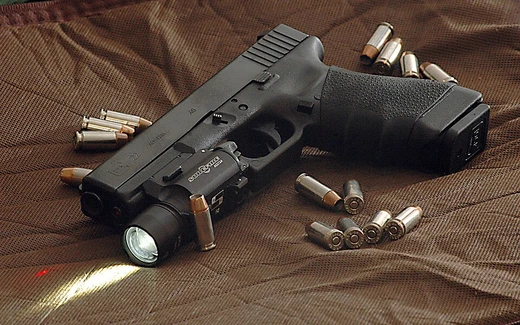
SIG Sauer P230
Compact blow-back pistol designed for concealed carry.
The SIG Sauer P230 is a compact, semi-automatic pistol offered in .32 ACP or .380 Auto. It was developed by the SIG Sauer facility in Eckernförde, Germany, and began U.S. importation through SIGARMS in 1985. Its small size makes it suitable as a backup or concealed carry firearm, with an 8+1 capacity in .32 ACP and a 7+1 capacity in .380 ACP (also called 9mm Kurz or Short).
**History** The P230 was created in 1977 as a concealable sidearm for law enforcement. After World War II, West German state police primarily used Walther PP and PPK models in .32 ACP, as no 9×19mm pistol was compact enough for concealed carry at the time. Terrorist incidents in West Germany during the early 1970s—including the 1972 Munich Massacre and Red Army Faction activities—prompted police to seek more powerful handguns. The P230 was submitted for consideration but was not chosen. Instead, West German police adopted 9mm Parabellum ammunition, selecting the SIG Sauer P225 (P6), Walther P5, and H&K P7, issued at each state’s discretion.
**Discontinuation** Imports of the SIG Sauer P232 to the United States, along with spare parts and magazines, ended in July 2014. While the P230 and P232 are known for reliability and accuracy, they faced increased competition from smaller, lighter, and cheaper .380 ACP pistols. Additionally, the German government banned exports of the P232 and other German-made SIG Sauer products due to unlawful foreign arms sales by the U.S. State Department to the Colombian Defense Ministry.
**Design** The P230 uses a simple fixed-barrel, straight blow-back design. It has a reputation as a well-made firearm, competing with the Walther PPK. Its narrow slide and frame allow for ankle holster or under-body-armor carry. It was offered in blued or all-stainless finishes. The blued version has a blued steel slide and anodized aluminum frame; the stainless version is entirely stainless steel. Both feature a molded polymer wrap-around grip contoured for a comfortable, secure hold. The factory trigger has a 24-newton (5.5 lbf) single-action pull and supports both single-action and double-action operation. Racking the slide sets the hammer to its single-action position, giving a short trigger pull with minimal take-up; the double-action pull is longer and stiffer.
Quick Facts
- Origin
- Germany, Switzerland
- Is Ranged
- yes
- Designer
- Walter Ludwig, Hanspeter Sigg, Peter Blickensdorfer
- Design Date
- 1977
- Manufacturer
- SIG Sauer, SIGARMS
- Production Date
- P230 1977–1996 / P232 1996–2015
- Weight
- 18.5 oz
- Length
- 6.6 in
- Part Length
- 3.6 in
- Height
- 4.7 in
- Cartridge
- .32 ACP, .380 ACP and 9×18mm Ultra
- Action
- Double Action/Single Action (DA/SA) With decocking lever
Facts from the source article.
Lore & Background
The SIG P230 was designed in 1977 as a concealable law enforcement sidearm. After World War II, West German state police mainly carried Walther PP and Walther PPK models chambered in .32 ACP, as no 9×19mm pistol was compact enough for concealed carry at the time. Terrorist incidents in West Germany circa the early 1970s, such as the 1972 Munich Massacre and Red Army Faction activities, pushed law enforcement to seek more powerful handguns. The P230 was submitted for the search but was not selected; the West German police decided to use 9mm Parabellum ammunition, with the SIG Sauer P225 (P6), Walther P5, and H&K P7 being selected and issued at the discretion of each state.
The design and function of the P230 is of the simple fixed barrel, straight blow-back configuration. It has a reputation as a well-built firearm and competes with the Walther PPK. With its relatively narrow slide and frame, it can be carried in an ankle holster or beneath body armor. The trigger is capable of both single-action and double-action. Pulling back the slide sets the hammer to its single-action position, making for a very short trigger pull with minimal take-up. The double-action pull is longer and more stiff. It has no external safeties, though it does have a de-cocking lever positioned just above the right-handed shooter's thumb on the left side of the grip. The lever provides a safe method of lowering the hammer from its full-cocked position to a 'half-cock' safe position. Once de-cocked, it is physically impossible for the hammer to drop completely and contact the firing pin. In order for the round to discharge, the full double-action pull must be completed, allowing the pistol to be carried reasonably safely with a round chambered. The P232 has an automatic firing pin safety.
The sights are of traditional SIG design, with a dot on the front sight and a rectangle on the rear sight. The magazine release is located behind and below the magazine floor plate; the magazine is released by pushing the lever towards the rear of the grip. Earlier models of the SIG P230 can be identified with 'Made in W.Germany' imprinted on the slide.
Reader's Guide
The SIG Sauer P230 was designed in 1977 as a concealable law enforcement sidearm, but it was not selected by West German police, who instead adopted 9mm Parabellum pistols. Despite this, the P230 found a role as a compact backup or concealed carry handgun, imported into the United States in 1985. Its straight blow-back design and fixed barrel contributed to its reputation for reliability and accuracy. The P230 was available in blued or all-stainless finishes, with a molded polymer wrap-around grip. It competed with the Walther PPK in the compact .380 ACP market. In 1996, it was replaced by the P232, which incorporated more than 60 changes, including a drop safety, dovetailed front sight, and thicker stippled grip panels. Imports of the P232 to the United States, and of spare parts and magazines, were discontinued in July 2014. The discontinuation was attributed to increased market competition from smaller, lighter, and less expensive .380 ACP pistols, as well as a ban on exports of German-manufactured SIG Sauer products by the German Government due to unlawful foreign arms sales by the U.S. State Department to the Colombian Defense Ministry. The P230 was used by various police forces in Japan, Libya, Switzerland, the United Kingdom (assigned L109A1), and the United States.
Did You Know?
- It holds 8 + 1 rounds of .32 ACP or 7 + 1 rounds of .380 ACP.
- The P230 was replaced in 1996 by the P232, which has over 60 design changes.
- Earlier models are marked 'Made in W.Germany' on the slide.
More in Semi-Automatic Pistols, Part 2 1-24
Spotted an error? Know more?
Reader corrections go straight into our review queue. Suggest an edit · How this site is sourced