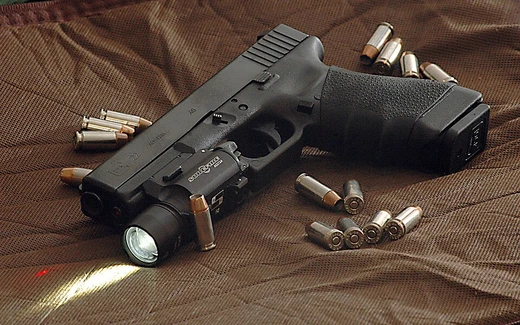
SIG Sauer P220
Swiss-designed service pistol adopted by multiple nations since 1975.
The SIG Sauer P220 is a semi-automatic pistol designed in 1975 by the SIG Arms AG division of Schweizerische Industrie Gesellschaft (now SIG Holding AG) and produced by J. P. Sauer & Sohn in Eckernförde. It was developed as a replacement for the SIG P210 for the Swiss Army, where it is known as the Pistole 75 (P75). The P220 introduced the SIG Sauer locking system and a double action / single action trigger design, and has been adopted by multiple nations for military use.
Quick Facts
- Service
- 1975–present
- Wars
- Lebanese Civil War
- Designer
- Walter Ludwig, Hanspeter Sigg, Eduard Brodbeck
- Length
- 196 mm
- Height
- 140 mm
- Action
- Short recoil operation
- Origin
- West Germany / Switzerland
- Is Ranged
- yes
- Design Date
- 1975
- Manufacturer
- SIG Sauer
- Weight
- 862 g / 1130 g stainless steel
- Part Length
- 112 mm
Facts from the source article.
Lore & Background
The SIG Sauer P220 was developed in 1975 by SIG and produced by J.P. Sauer & Sohn of Germany, marking the beginning of the SIG Sauer partnership. It was adopted by the Swiss Army as the Pistole 75 (P75) chambered in 9 mm Parabellum. Other military adopters include Japan (general issue) and Denmark (special forces only). Upon completion of military service, Swiss soldiers can obtain ownership of their P220 for a nominal fee of thirty Swiss francs. In the United States, the P220 was initially sold in modified form as the Browning BDA from 1977 to 1980.
The P220 uses the SIG Sauer locking system, where an enlarged breech section on the barrel locks into the ejection port, rather than the locking lugs of Browning-derived designs. The slide is a heavy-gauge sheet metal stamping with a welded-on nose section and a machined breech block insert. The frame is forged alloy with hard-anodized coating. The double action / single action trigger design incorporates a hammer-drop lever, first seen on the Sauer 38H. The pistol features an automatic firing pin block safety activated by the trigger mechanism. The first shot is double-action (trigger pull approximately 12–14 pounds), with subsequent single-action shots at about 6 pounds.
Variants include the P220R (with Picatinny rail), P220ST (stainless steel frame and slide), DAO, DAK, single action (with M1911-style safety), SAS (anti-snag), Elite (with short-reset trigger), and the 2019 P220R Hunter chambered in 10mm with KRYPTEC camo. Older models had heel-mounted magazine releases and stamped slides with removable breech blocks; newer models have push-button releases and CNC-milled one-piece slides.
Reader's Guide
The SIG Sauer P220 holds significance as the foundational design of the SIG Sauer pistol lineage, introducing the SIG Sauer locking system and the double action / single action trigger with a decocking lever that became standard on subsequent models like the P226. Its adoption by the Swiss Army as the Pistole 75 established a military pedigree, and its use by Japan and Danish special forces further cemented its reputation. The P220's design innovations—including the four-point safety system and the use of a stamped slide with a machined breech block—represented a departure from earlier Browning-derived pistols. The pistol's evolution from heel-mounted to push-button magazine releases, and from stamped to milled slides, reflects ongoing refinement. The introduction of variants such as the P220R, P220ST, and specialized models like the SAS and Elite demonstrates its adaptability to different roles, from military service to concealed carry. The P220 also served as the basis for the Browning BDA, which introduced the design to the American market. Despite its safety features, the P220 has been cited in accidental fatalities, such as the 2002 incident involving Officer Jesse Paderez, where a dropped weapon discharged upon hammer impact with the pavement.
Did You Know?
- The SIG Sauer P220 is known as the Pistole 75 (P75) in Swiss Army service.
- Swiss soldiers can purchase their service P220 after military service for a fee of thirty Swiss francs.
- The P220 was initially sold in the United States as the Browning BDA from 1977 to 1980.
- The P220 introduced the SIG Sauer locking system, which uses an enlarged breech section locking into the ejection port.
More in Semi-Automatic Pistols, Part 2 1-24
Spotted an error? Know more?
Reader corrections go straight into our review queue. Suggest an edit · How this site is sourced