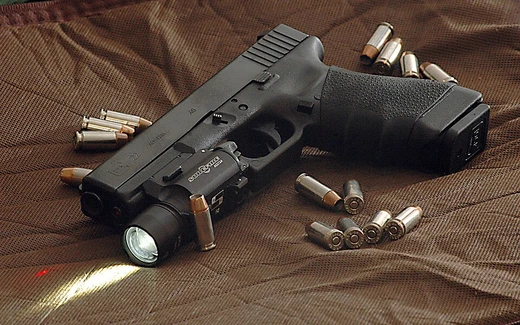
Mauser HSc
A German double-action pistol produced through World War II and beyond.
The Mauser HSc is a 7.65mm semi-automatic pistol that first appeared in Nazi Germany during World War II and remained in production until 1977. The name HSc is short for *Hahn Selbstspanner* (“self-cocking hammer”) Pistole, the third and final design in the “C” series. Its design includes a semi-exposed hammer, a double-action trigger, a single-column magazine, and a spring that wraps around the barrel. Though originally developed as a commercial pistol, it went up against the Walther PPK, Walther PP, and Sauer 38H for contracts with German police and military forces. The Kriegsmarine was the first to adopt it, followed by the Army and police; any HSc pistols used by the Luftwaffe or Waffen-SS came from Army or police stocks.
Quick Facts
- Origin
- Nazi Germany
- Is Ranged
- yes
- Service
- 1940–1945
- Used By
- Nazi Germany / France
- Wars
- World War II / First Indochina War / 1958 Lebanon crisis / Lebanese Civil War / Burundian Civil War
- Designer
- Alex Seidel
- Design Date
- 1935–36
- Manufacturer
- Mauser
- Production Date
- 1940–1977
- Number
- Over 334,000
- Variants
- HSc Super
- Weight
- 700 g unloaded
Facts from the source article.
Lore & Background
Production of the Mauser HSc began in late 1940 at serial number 700,000, as an extension of the serial number range of the Mauser Model 1934 pistol. Early pistols had well-made wooden grips, high polish, and rich bluing. The first 1,350 pistols were made for the commercial market and, due to low positioning of the grip screws, became known as the 'Low Grip Screw' variety. Approximately half of this initial production was purchased by the Kriegsmarine. At approximately serial number 701,345, the grip screws were relocated upward to a more central and sturdier position.
The German Army began HSc procurement with an initial order for 3,000 pistols in early 1941, beginning with serial number 701,345 and ending about #712,000. Subsequent orders were placed throughout the war, with further pistols procured by the Police and Kriegsmarine. Almost 24% of the total production of 252,000 pistols went to the commercial market. The pistol underwent several variations during World War II, with changes in acceptance marks, finish quality, and markings. The last variation, of some 32,000 pistols in the serial number range of about #886,000 to #952,000, included some with black plastic grip panels and, in the very late range, a phosphate finish similar to U.S. parkerizing.
After the fall of Nazi Germany, production resumed in the French occupation zone until 1946. HSc pistols made by the French bear an RW proof and were destined for French forces fighting in the First Indochina War. High-quality commercial production resumed at the Mauser factory from 1968 to 1977, with most going to German police units and others exported, primarily to North America. The majority of 1970s models were chambered in 9×17mm (.380 ACP). A variant called the 'HSc Super,' 'HSc Mod. 80,' or 'SAB-2001 Super' was made by Renato Gamba in Italy under licence, chambered in .32 ACP, .380 ACP, and 9×18mm Ultra, with a double-column magazine and an 'American-style' magazine release.
Reader's Guide
The Mauser HSc is significant as a German double-action pocket pistol that saw extensive use by military and police forces during World War II, as well as commercial sales. Its design, with a semi-exposed hammer and spring surrounding the barrel, was a notable alternative to the Walther PPK and Sauer 38H. The pistol's production spanned from 1940 to 1977, including a brief period under French occupation and a later commercial revival. The HSc's variations, particularly the late-war phosphate-finished examples and the rare 'Low Grip Screw' early pistols, are of interest to collectors. The pistol's legacy includes its use as a war souvenir and its continued presence in the commercial market, with later models chambered in .380 ACP. The licensed Italian variant further extended its design influence.
Did You Know?
- The HSc designation stood for Hahn Selbstspanner ('self-cocking hammer') Pistole, third and final design 'C'.
- The first 1,350 pistols, known as the 'Low Grip Screw' variety, are very rare today.
- Almost 24% of the total World War II production of 252,000 pistols went to the commercial market.
- Late-war HSc pistols in the #949,500 to #952,000 range were finished with Mauser's phosphate finish, similar to U.S. parkerizing.
More in Semi-Automatic Pistols, Part 2 1-24
Spotted an error? Know more?
Reader corrections go straight into our review queue. Suggest an edit · How this site is sourced