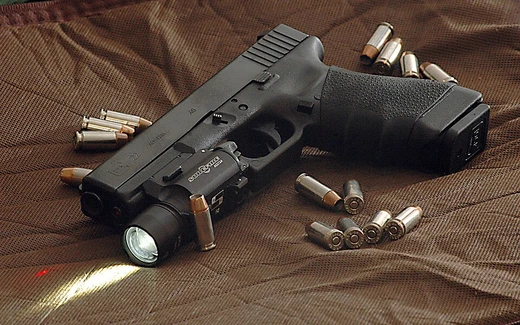
KelTec P32
Sub-compact .32 ACP with short-recoil locked breech for concealed carry.
The KelTec P32 is a sub-compact semi-automatic pistol chambered in .32 ACP (7.65mm Browning). Designed by George Kellgren and manufactured by KelTec CNC Industries Inc. of Cocoa, Florida, it was intended for concealed carry by citizens and law enforcement officers. Unlike most blowback pocket pistols of the 20th century, the P32 operates on Browning's short-recoil principle with a locked breech, a design that mitigates recoil despite its very low weight.
Quick Facts
- Origin
- United States
- Is Ranged
- yes
- Used By
- Private citizens and police officers
- Designer
- George Kellgren
- Design Date
- 1999
- Manufacturer
- KelTec CNC Industries Inc.
- Production Date
- 1999–present
- Weight
- 6.6 oz unloaded.
- Length
- 5.07 in
- Part Length
- 2.68 in
- Height
- 3.50 in
- Cartridge
- .32 ACP
Facts from the source article.
Lore & Background
The P32 was designed by George Kellgren and is produced by KelTec CNC Industries, a company founded in 1991 and based in Cocoa, Florida. Its barrel length is 2.68 inches (68 mm). The pistol is notable for using Browning's short-recoil principle with a locked breech, a departure from the blowback operation common in pocket pistols of the 20th century. This approach became more popular in subsequent decades.
The P32 has no manual safety, relying instead on a long double-action trigger pull and an internal hammer block for safe operation. It meets SAAMI guidelines and will not fire if dropped; the pistol passed extensive SAAMI drop-testing at H. P. White labs as well as drop tests to military specifications. The trigger must physically be pulled for the gun to fire.
Materials used include SAE 4140 ordnance steel for the barrel and slide, 7075-T6 aluminum for the internal frame (machined from a solid block), and Dupont ST-8018 ultra-high-impact polymer for the checkered grip, frame, and trigger.
Reader's Guide
The KelTec P32 occupies a distinct place in the history of semi-automatic pistols as an early example of a sub-compact firearm that employed a locked-breech short-recoil system rather than the simpler blowback action typical of pocket pistols. This design choice allowed the P32 to manage recoil effectively despite its low weight, a feature that became more common in later compact pistols. Its construction combined ordnance steel, machined aluminum, and high-impact polymer, reflecting a blend of traditional and modern materials. The absence of a manual safety, replaced by a long double-action trigger and an internal hammer block, aligned the P32's operation more closely with that of a revolver. The pistol's passing of both SAAMI and military-specification drop tests underscored its safety credentials. Designed for concealed carry by both private citizens and law enforcement officers, the P32 helped establish a market niche for lightweight, easily concealable pistols chambered in .32 ACP.
Did You Know?
- It has no manual safety; safe operation relies on a long double-action trigger pull and an internal hammer block.
- The internal frame is machined from a solid block of 7075-T6 aluminum.
More in Semi-Automatic Pistols, Part 2 1-24
Spotted an error? Know more?
Reader corrections go straight into our review queue. Suggest an edit · How this site is sourced