Frequently Asked Questions
The most-asked questions about seahorses and pipefish.
What are seahorses and pipefish?
They are small, bony fish in the family Syngnathidae that inhabit shallow coastal waters around the globe. They have elongated tubular bodies, a horse-like head shape (in seahorses), and swim upright using tiny dorsal and pectoral fins rather than a tail.
How are seahorses and pipefish related?
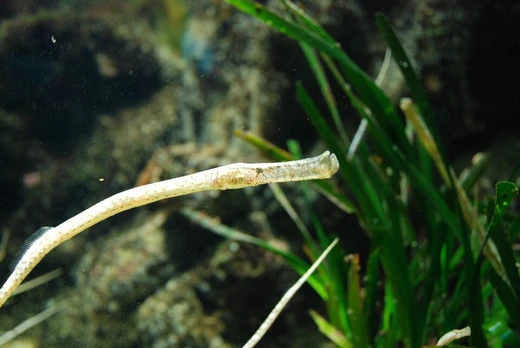
Both belong to the same family, Syngnathidae, and share traits like bony-plated bodies and a long snout used to suck up prey. Pipefish are generally more slender and lack the coiled tail and prominent bony rings that make seahorses instantly recognizable.
What is the most famous fact about seahorses?
The male carries the eggs in a specialized brood pouch on his belly, a rare case of male pregnancy in the animal kingdom. After the female transfers her eggs, the male fertilizes and incubates them for several weeks before releasing live young.
How do seahorses and pipefish swim?
They rely on a small dorsal fin for forward thrust and tiny pectoral fins for steering, producing a distinctive undulating, upright motion. Because they lack a caudal fin, they appear to bob and sway rather than swim in the typical fish manner.
What do they eat?
They are ambush predators that use their long, tubular mouths to vacuum up tiny crustaceans, copepods, and small shrimp. They have no true stomach and a very short digestive tract, so they must feed continuously throughout the day.
How long do seahorses and pipefish live?
Most species live roughly two to five years in the wild, though some larger seahorse species can approach seven years. In well-maintained aquariums, individuals occasionally exceed these wild ranges slightly.
Where do they live?
They inhabit shallow, warm-to-temperate coastal waters, often sheltering among seagrass beds, mangrove roots, coral reefs, or kelp forests. Over 45 seahorse species and more than 200 pipefish species are found across every ocean except the polar regions.
How can I tell a seahorse from a pipefish at a glance?
Look for a coiled, prehensile tail and prominent bony plates or rings around the body—those are seahorse hallmarks. Pipefish tend to be more cylindrical, lack a grasping tail, and often have a more streamlined, eel-like profile.
Are seahorses and pipefish endangered?
Many seahorse species are listed as vulnerable or near-threatened by the IUCN due to habitat loss, trawling bycatch, and demand for traditional medicine. Pipefish are less studied, but the same pressures on coastal ecosystems threaten them as well.
Where should a newcomer start learning about seahorses and pipefish?
A good first step is familiarizing yourself with the three main seahorse genera and the broader Syngnathidae family, then watching slow-motion footage of their feeding and courtship behavior. From there, exploring species-specific profiles and ongoing conservation campaigns will deepen your understanding.