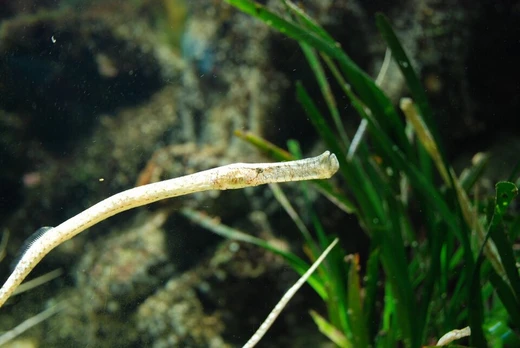
Doryrhamphus negrosensis
A small pipefish with a flag-like tail, found in Western Pacific reefs.
Last updated

Silke Baron · via Wikipedia: Doryrhamphus negrosensis · CC BY 3.0
Doryrhamphus negrosensis is a marine fish in the family Syngnathidae, commonly called the Negros pipefish or flagtail pipefish.[1] The species was described by Herre in 1934.[2][3] It is accepted as a valid species in both the World Register of Marine Species and the GBIF Backbone Taxonomy.[3][4]
Scientific classification
- KingdomAnimalia
- PhylumChordata
- ClassActinopterygii
- DivisionTeleostei
- OrderSyngnathiformes
- FamilySyngnathidae
- GenusDoryrhamphus
- SpeciesDoryrhamphus negrosensis
Named by Herre, 1934
Close relatives
Other species of Doryrhamphus with a Codexery entry.
- Doryrhamphus excisus Doryrhamphus excisus
- Doryrhamphus janssi Doryrhamphus janssi
Sources: Wikipedia taxobox: Doryrhamphus negrosensis (CC BY-SA 4.0) · order, family and genus agree with WoRMS AphiaID 293587 (CC BY 4.0)
Conservation status
Least Concern (LC)
- LC▲ this species
- NT
- VU
- EN
- CR
- EW
- EX
Source: IUCN Red List assessment · GBIF copy of the Red List category
Where the doryrhamphus negrosensis has been recorded
Each dot is a place where the species has been observed and reported (73 records, half-degree grid) — not a modelled range. 2 inland records left out (institution coordinates).
Map: drawn by Codexery. Data: GBIF occurrence search (records CC0 / CC BY) · Natural Earth basemap (public domain) · place coordinates: Wikipedia (CC BY-SA 4.0)
Quick Facts
- Common names
- Negros pipefish
- flagtail pipefish
- Masthead Island pipefish
- Queensland flagtail pipefish
- Family
- Syngnathidae
- Habitat
- Mud flats and reefs (coral and rocky), often associated with sea urchins
- Reproduction
- Ovoviviparous, males carry eggs and give birth to live young; males may brood at 4.3 cm / 1.69 in
Facts from the source article.
Biology and range
Its body is small and bluish to bluish-grey, with a pale stripe along the top of the head and snout.[2][5] The caudal fin is dark, fan-like, with white margins and an orange base.[2][5] Little is known of its feeding habits, but it is expected to eat harpacticoid copepods, gammarid shrimps, and mysids, similar to other pipefish.[6] It may also act as a cleaner fish, like other species in the genus Doryrhamphus.[6]
This species tends to be solitary, though it can sometimes be observed in pairs or small aggregations.[6] Maximum recorded depth for this fish is 9 meters, and its greatest known length is 6.2 cm.[6] When males reach a length of 4.3 cm, they may begin brooding.[5]
What the specialist sources record
That account lists the species citation as Doryrhamphus negrosensis Herre 1934.[2] The GBIF database holds 117 occurrence records for this taxon as of October 2026.[4] The World Register of Marine Species records the species as accepted, with the environment listed as marine.[3]
References
- Wikipedia, "Doryrhamphus negrosensis" (CC BY-SA 4.0), which cites: Pollom, R., "Doryrhamphus negrosensis", 2016 (original not read by us) en.wikipedia.org
- "Doryrhamphus negrosensis", Fishes of Australia. facts only, no text reused. fishesofaustralia.net.au
- World Register of Marine Species, Doryrhamphus negrosensis (AphiaID 293587). CC BY 4.0. marinespecies.org
- GBIF Backbone Taxonomy and occurrence index, Doryrhamphus negrosensis (taxon key 4286275). CC BY 4.0 (backbone); counts are facts. gbif.org
- Wikipedia, "Doryrhamphus negrosensis" (CC BY-SA 4.0), which cites: Myers, R.F., 1991. Micronesian reef fishes. Second Ed. Coral Graphics, Barrigada, Guam. p. 298; "Doryrhamphus negrosensis", Fishes of Australia (we also read that source) en.wikipedia.org
- Wikipedia, "Doryrhamphus negrosensis" (CC BY-SA 4.0), which cites: ; Myers, R.F., 1991. Micronesian reef fishes. Second Ed. Coral Graphics, Barrigada, Guam. p. 298; "Doryrhamphus negrosensis", Fishes of Australia; Pollom, R., "Doryrhamphus negrosensis", 2016 (we also read that source) en.wikipedia.org
Each numbered sentence above was checked against the source it cites before publication. Sentences citing Wikipedia adapt text from the English Wikipedia article Doryrhamphus negrosensis (contributors), used under CC BY-SA 4.0; this entry is available under the same licence. Other sources were used for facts only; no text or images are copied from them.
More in Seahorses and Pipefish
Sources
Compiled from Wikipedia and the sources listed below. Text from Wikipedia is available under CC BY-SA 4.0; this entry is adapted from it.
- Wikipedia: Doryrhamphus negrosensis (CC BY-SA 4.0).
- Classification: the source article's taxobox; order, family and genus checked against WoRMS, the World Register of Marine Species (CC BY 4.0).
- Conservation status: IUCN Red List assessment.
- Occurrence records: GBIF (CC0 / CC BY). Basemap: Natural Earth (public domain).
- Word definitions: the , each quoted from its Wikipedia article.
Spotted an error? Know more?
Reader corrections go straight into our review queue. Suggest an edit · How this site is sourced