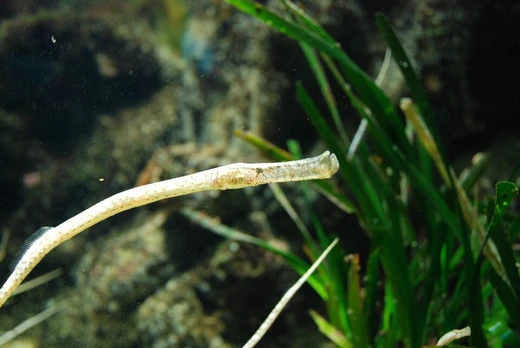
Pipefish
Straight-bodied relatives of seahorses with male parental care.

Pipefishes (Syngnathinae) are a subfamily of small fish that, along with seahorses and seadragons, belong to the family Syngnathidae. The name derives from the Ancient Greek words for "together" and "jaw," a reference to the fused jaw shared by all species in this subfamily. These fish resemble straight-bodied seahorses with tiny mouths. Their snout is long and tube-like, ending in a narrow, toothless mouth that opens upward. The body and tail are long, thin, and snake-like, and the skeleton is modified into armored plating with several longitudinal ridges. As a result, a cross-section of the body appears angular rather than round or oval. A dorsal fin is always present and serves as the main (and sometimes only) organ for movement. Ventral fins are always absent, while other fins may or may not be developed. Gill openings are very small and located near the upper rear corner of the gill cover. Many pipefish are weak swimmers in open water, moving slowly by rapidly fluttering their dorsal fin. Some species have prehensile tails like seahorses, but most have a caudal fin (unlike seahorses) that can also be used for swimming. In the group known as flagtail pipefish, the caudal fin is more developed, making them quite strong swimmers. Most pipefish live in marine environments; only a few are freshwater species. They are abundant along coasts in tropical and temperate zones, typically reaching 35–40 cm in length. They generally inhabit sheltered areas such as coral reefs or seagrass beds. Because they are poor swimmers, pipefish often live in shallow waters easily disturbed by industrial runoff and human recreation. Boats and drag lines that move shoreline sediment also affect their habitats, reducing the seagrasses and eelgrasses vital to them. Their narrow range suggests they have limited ability to adapt to new or changing habitats. Another factor that affects pipefish populations is their use in traditional Chinese medicine (TCM) remedies, despite the lack of evidence of efficacy beyond placebo. Syngnathidae are in high demand for these pseudo-scientific remedies. Like seahorses, male pipefish handle nearly all parenting duties, providing all postzygotic care.
Quick Facts
- Taxon
- Syngnathinae
Facts from the source article.
Lore & Background
Pipefish look like straight-bodied seahorses with tiny mouths. The name is derived from the peculiar form of the snout, which is like a long tube, ending in a narrow and small mouth that opens upwards and is toothless. The body and tail are long, thin, and snake-like, and they have a highly modified skeleton formed into armored plating with several longitudinal ridges, making a vertical section through the body angular. A dorsal fin is always present and is the principal organ of locomotion; ventral fins are consistently absent. Many are very weak swimmers in open water, moving slowly by rapid movements of the dorsal fin. Some species have prehensile tails, and most have a caudal fin, unlike seahorses. Most pipefishes are marine dwellers; only a few are freshwater species. They are abundant on coasts of the tropical and temperate zones, generally inhabiting sheltered areas in coral reefs or seagrass beds. Due to their lack of strong swimming ability, they are often found in shallow waters easily disturbed by industrial runoffs, human recreation, boats, and drag lines, which cause a decrease in seagrasses and eelgrasses vital to their habitats. Their narrow range distribution indicates they are less able to adapt to new habitats or habitat change. They are also used in traditional Chinese medicine remedies, despite lack of evidence of efficacy beyond placebo, and are more exploited than seahorses due to a belief in their higher potency. The aquarium trade of pipefish has also increased in recent years.
Reader's Guide
Pipefish are significant within the family Syngnathidae for their unique reproductive biology, where males provide all postzygotic care, brooding offspring either on a distinct region of their body or in a brood pouch. Brood pouches vary among species, but all contain a small opening for egg deposition. The evolution of male brooding is thought to result from a reproductive advantage granted to ancestors that deposited eggs onto males, who could escape predation. Courtship involves lengthy, complicated displays, such as the ritualized dance in Syngnathus typhle, which includes wriggling and shaking motions. Under predator threat, pipefish copulate less frequently and dance less per copulation. Males are the limiting sex due to physical limits on egg carriage, and females can produce more eggs than males can accommodate. Male pipefish invest more energy than females per zygote and may consume embryos to regain energy, a form of filial cannibalism. Young are born free-swimming and independent. Pair bonding varies widely, with many species exhibiting polyandry, where one female mates with multiple males, more common in internal-brooding species. Polyandrous species often have females with complex sexual signals like ornaments.
Did You Know?
- Pipefish have a fused jaw, reflected in their name from Greek words meaning 'together' and 'jaw'.
- Male pipefish provide all postzygotic care, brooding eggs in a pouch or on a patch of skin.
- Some male pipefish may consume their own embryos to regain energy when exhausted.
- Pipefish are more exploited than seahorses in traditional Chinese medicine due to a belief in their higher potency.
More in Seahorses and Pipefish 1-24
Spotted an error? Know more?
Reader corrections go straight into our review queue. Suggest an edit · How this site is sourced