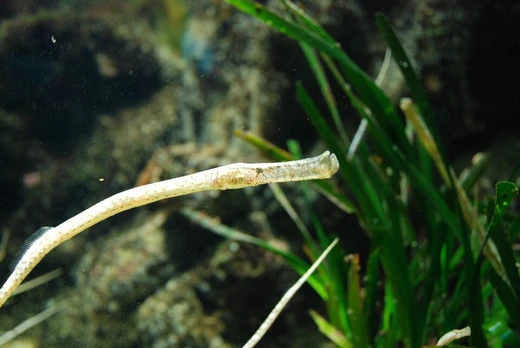
Phycodurus
Monotypic genus of marine fish, the leafy seadragon.

Phycodurus is a genus of marine fish in the family Syngnathidae, which includes seadragons, pipefish, and seahorses. It is a monotypic genus, containing only the leafy seadragon (Phycodurus eques), also known as Glauert's seadragon. The genus is notable for its single species, which is the marine emblem of the state of South Australia and a focus for local marine conservation.
Quick Facts
- Genus
- Phycodurus
- Species
- eques
Facts from the source article.
Lore & Background
The generic name Phycodurus is derived from the Ancient Greek words φῦκος (phûkos) meaning 'seaweed' and δέρμα (dérma) meaning 'skin'. The species name eques comes from the Latin equus, meaning 'horse'. The leafy seadragon is found along the southern and western coasts of Australia, from Wilson's Promontory in Victoria westward to Jurien Bay in Western Australia. It is mostly found over sand patches in waters up to 50 m deep, around kelp-covered rocks and clumps of seagrass.
The leafy seadragon propels itself using a pair of pectoral fins on the sides of its neck and a dorsal fin on its back closer to the tail end. These small fins are almost completely transparent and undulate minutely to move the creature sedately through the water, completing the illusion of floating seaweed. The lobes of skin on its body provide camouflage, giving it the appearance of seaweed. It can also change colour to blend in, depending on diet, age, location, and stress level. Unlike seahorses, it cannot coil or grasp things with its tail.
Reproduction involves the male caring for the eggs. The female deposits up to 250 bright pink eggs onto the male's tail using her ovipositor. The eggs attach to a brood patch that supplies oxygen. After about 9 weeks, the eggs hatch over 24–48 hours, with the male shaking his tail and rubbing it against seaweed and rocks to aid hatching. The young are completely independent from hatching.
Reader's Guide
The leafy seadragon, the sole member of Phycodurus, holds significant cultural and ecological importance in southern Australia. It is the official marine emblem of South Australia and is featured in the logos of the Adelaide University Scuba Club Inc. and the Marine Life Society of South Australia Inc. A biennial Leafy Sea Dragon Festival is held within the District Council of Yankalilla in South Australia, celebrating the environment, arts, and culture of the Fleurieu Peninsula. The inaugural festival in 2005 attracted over 7,000 participants.
Conservation efforts have been substantial due to threats from pollution, industrial runoff, and collection for the aquarium trade. The species has been totally protected in South Australia since 1987, Victoria since at least 1995, and Western Australia since 1991. It is also listed under the Australian government's Environment Protection and Biodiversity Conservation Act 1999, requiring consideration in developmental projects. In captivity, seadragons are difficult to maintain and breeding attempts have so far been unsuccessful. They are displayed in numerous public aquaria worldwide, including in Australia, Canada, Singapore, the United States, and Europe. An animated short film, 'The Amazing Adventures of Gavin, a Leafy Seadragon', was made in 2006 by several South Australian organisations to promote marine conservation.
Did You Know?
- The leafy seadragon is the only member of the genus Phycodurus.
- Its name comes from Ancient Greek words meaning 'seaweed' and 'skin'.
- The male cares for the eggs, which number up to 250 and hatch after about 9 weeks.
- Only about 5% of the eggs survive to hatching.
More in Seahorses and Pipefish 1-24
Spotted an error? Know more?
Reader corrections go straight into our review queue. Suggest an edit · How this site is sourced