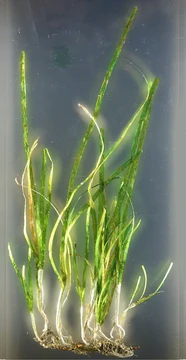
Halophila
A genus of seagrasses with unisexual flowers and salt-loving name.
Last updated
Belonging to the Hydrocharitaceae family (the tape-grasses), the genus Halophila comprises marine flowering plants.[1] The genus was first formally described in 1806.[1] Its Latin name, halophila, signifies an affinity for salt.[2]
Scientific classification
- CladeTracheophytes
- CladeAngiosperms
- CladeMonocots
- OrderAlismatales
- FamilyHydrocharitaceae
- GenusHalophila
Named by Thouars
Sources: Wikipedia taxobox: Halophila (CC BY-SA 4.0)
Quick Facts
- Family
- Hydrocharitaceae
- Order
- Alismatales
- Year described
- 1806
Facts from the source article.
Key facts and history
The genus is widespread in tropical waters, also extending to subtropical and temperate waters.[3] These marine herbs feature creeping stoloniferous stems and nodes with leaves, living fully submerged.[4] In contrast to many seagrasses, certain Halophila species lack basal sheaths on their leaves.[4] Stalks support the male flowers.[5]
What the cited sources add
The Open Library record confirms that "A gardener's dictionary of plant names" was published by Cassell in 1972.[6][2]
References
- Wikipedia, "Halophila" (CC BY-SA 4.0), which cites: Louis-Marie Aubert du Petit-Thouars 1806. Genera Nova Madagascariensia 2 (original not read by us) en.wikipedia.org
- Wikipedia, "Halophila" (CC BY-SA 4.0), which cites: Stearn, "A Gardenerer's Dictionary of Plant Names", Cassell, 1972 (we also read that source) en.wikipedia.org
- Wikipedia, "Halophila" (CC BY-SA 4.0), which cites: "World Checklist of Selected Plant Families: Royal Botanic Gardens, Kew", apps.kew.org; Phillips, "The genera of South African flowering plants", Government Printer, 1951 (original not read by us) en.wikipedia.org
- Wikipedia, "Halophila" (CC BY-SA 4.0), which cites: Phillips, "The genera of South African flowering plants", Government Printer, 1951; Halophila engelmannii star grass Florida Fish and Wildlife Conservation Commission. Retrieved 2012-01-28. (original not read by us) en.wikipedia.org
- Wikipedia, "Halophila" (CC BY-SA 4.0), which cites: Phillips, "The genera of South African flowering plants", Government Printer, 1951 (original not read by us) en.wikipedia.org
- Open Library record, ISBN 0304937215 ("A gardener's dictionary of plant names"). CC0 (metadata); book content not read. openlibrary.org
Each numbered sentence above was checked against the source it cites before publication. Sentences citing Wikipedia adapt text from the English Wikipedia article Halophila (contributors), used under CC BY-SA 4.0; this entry is available under the same licence. Other sources were used for facts only; no text or images are copied from them.
More in Seagrasses
Test yourself
Three questions drawn from this entry’s sources. Pick an answer to check it.
Answers checked against the source article
Sources
Compiled from Wikipedia and the sources listed below. Text from Wikipedia is available under CC BY-SA 4.0; this entry is adapted from it.
- Wikipedia: Halophila (CC BY-SA 4.0).
- Word definitions: the Codexery glossary, each quoted from its Wikipedia article.
Spotted an error? Know more?
Reader corrections go straight into our review queue. Suggest an edit · How this site is sourced