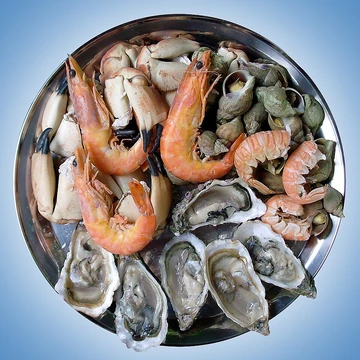
Lobster
Last updated
Lobsters are decapod crustaceans of the family Nephropidae, with long bodies, muscular tails, and claws on three of their five pairs of legs.[1][2] They live in crevices or burrows on the sea floor and are highly prized as seafood.[1][2]
Scientific classification
- KingdomAnimalia
- PhylumArthropoda
- CladePancrustacea
- ClassMalacostraca
- OrderDecapoda
- SuborderPleocyemata
- FamilyNephropidae
Named by Dana, 1852
Sources: Wikipedia taxobox: Lobster (CC BY-SA 4.0)
Key facts and history
Lobsters have a hard protective exoskeleton and must shed it to grow, leaving them vulnerable.[3] The first US lobster cannery opened in Eastport, Maine in the 1840s.[4] By 1880, Maine had 23 lobster canneries.[4] The family Nephropidae contains the clawed lobsters that are typically meant when someone uses the word "lobster" without any qualifier.[5]
A color change occurs in certain lobster species when they undergo molting.[6] Copper-containing hemocyanin is the substance that gives lobsters, along with snails and spiders, their blue-colored blood.[7] Evidence of human consumption of lobster in prehistoric times comes from substantial accumulations of their shells.[8] During the middle and later parts of the Roman period, lobster was considered a moderately priced delicacy.[8]
The earliest known mention of lobster in cookery texts appears in documents from the medieval period.[9]
What the cited sources add
The Page account notes that lobster became one of the first foods to be commercially canned in the United States.[10] Consumer demands for canned lobster drove increased harvests, sparking concerns about sustainability.[10] The "Fun Facts" account states that the "true" American lobster has claws on the first four legs, while the spiny lobster does not.[11] The item marketed as "lobster tail" usually is a spiny lobster.[11]
References
- Wikipedia, "Lobster" (CC BY-SA 4.0), which cites: "A classification of living and fossil genera of decapod crustaceans", Raffles Bulletin of Zoology, 2009, p. 1–109; Poore, "The Names of the Higher Taxa of Crustacea Decapoda", Journal of Crustacean Biology, March 2016, p. 248–255 (original not read by us) en.wikipedia.org
- Wikipedia, "Lobster" (CC BY-SA 4.0), which cites: "Homarus americanus, American lobster", McGill University, June 27, 2007 (original not read by us) en.wikipedia.org
- Wikipedia, "Lobster" (CC BY-SA 4.0), which cites: "Studies on the quaternary structure of the lobster exoskeleton carotenoprotein, crustacyanin", Comparative Biochemistry and Physiology Part B: Comparative Biochemistry, 1977, p. 55–61 (original not read by us) en.wikipedia.org
- Wikipedia, "Lobster" (CC BY-SA 4.0), which cites: Page, "A fishery transformed by canning", Island Institute, November 24, 2025; Harrison, "The Discoloration, Smut, Or Blackening of Canned Lobster", Transactions, 1923, p. 146–149; MacDonald, Edward. "Economic dislocation and resiliency on Prince Edward Island: small producer, distant markets." London Journal of Canadian Studies 31 (2016):; Macdonald, "Time and a Place: An Environmental History of Prince Edward Island", McGill-Queen's Press - MQUP, 2016-06-01, p. 227; Page, "A fishery transformed by canning", Island Institute, November 24, 2025 en.wikipedia.org
- Wikipedia, "Lobster" (CC BY-SA 4.0), which cites: Scott, "ABC Biologie", Walter de Gruyter, 1996, p. 703 (original not read by us) en.wikipedia.org
- Wikipedia, "Lobster" (CC BY-SA 4.0), which cites: Robles, "Encyclopedia of tidepools and rocky shores", University of California Press, 2007, p. 333–335 (we also read that source) en.wikipedia.org
- Wikipedia, "Lobster" (CC BY-SA 4.0), which cites: "Copper for life – Vital copper", Association for Science Education (original not read by us) en.wikipedia.org
- Wikipedia, "Lobster" (CC BY-SA 4.0), which cites: Townsend 2011, p. 24–26 (original not read by us) en.wikipedia.org
- Wikipedia, "Lobster" (CC BY-SA 4.0), which cites: "James Prescott - Le Viandier de Taillevent - Translation - Round Saltwater Fish", www.telusplanet.net (original not read by us) en.wikipedia.org
- Page, "A fishery transformed by canning", Island Institute, November 24, 2025. islandinstitute.org
- "Fun Facts About Luscious Lobsters", Outreach and Education. fisheries.noaa.gov
Each numbered sentence above was checked against the source it cites before publication. Sentences citing Wikipedia adapt text from the English Wikipedia article Lobster (contributors), used under CC BY-SA 4.0; this entry is available under the same licence. Other sources were used for facts only.
Sources
Compiled from Wikipedia and the sources listed below. Text from Wikipedia is available under CC BY-SA 4.0; this entry is adapted from it.
- Wikipedia: Lobster (CC BY-SA 4.0).
Spotted an error? Know more?
Reader corrections go straight into our review queue. Suggest an edit · How this site is sourced