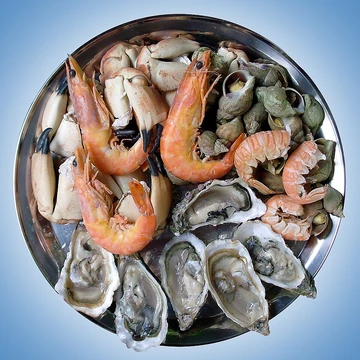
Lobster
Clawed crustaceans of the family Nephropidae, valued as seafood.

Wikipedia / Wikimedia Commons
Lobsters are a type of decapod crustacean classified under the family Nephropidae (also called Homaridae). They have elongated bodies and strong, muscular tails, and they typically inhabit crevices or burrows on the ocean floor. Of their five pairs of legs, three have claws, with the front pair being noticeably larger than the rest. Highly valued as seafood, lobsters are a major economic resource, often ranking among the most profitable catches in the coastal regions where they are found.
Key commercial species include two species from the genus *Homarus* in the northern Atlantic Ocean, the smaller *Nephrops norvegicus* (known as true scampi, Norway lobster, or langoustine), and several smaller species in the genus *Metanephrops*, commonly called Pacific scampi.
**Distinction**
While other crustacean groups include "lobster" in their names, the term by itself usually refers to the clawed lobsters of Nephropidae. These clawed lobsters are not closely related to spiny or slipper lobsters (which lack claws) or to squat lobsters. Their closest living relatives are reef lobsters and three families of freshwater crayfish. In the United States, only the *Homarus* species—*H. gammarus* (European lobster) and *H. americanus* (American lobster)—can be sold simply as "lobster" without qualification. In cooking, "lobster" in North America almost always means the American lobster, while in Great Britain it refers to the European lobster. Other species, whether clawed (like the Norway lobster) or not (like the spiny lobster), require qualified names. In the Caribbean, *Panulirus argus* is formally called the spiny lobster but is often just called "lobster" informally. In other English-speaking regions, the unqualified term is rarely used.
**Description**
**Body**
Lobsters are invertebrates with a hard exoskeleton that they must shed to grow, a process that leaves them vulnerable. During molting, several species change color. They have eight walking legs, with the front three pairs bearing claws, the first of which are larger. These front pincers are considered legs, placing lobsters in the order Decapoda ("ten-footed"). Though mostly bilaterally symmetrical, some genera have unequal, specialized claws. The body has two main parts: the cephalothorax (fused head and thorax, covered by a chitinous carapace) and the abdomen. The head has antennae, antennules, mandibles, two pairs of maxillae, and usually stalked compound eyes. Because lobsters live in murky seafloor environments, they rely mainly on their antennae as sensors. Their eyes have a reflective structure above a convex retina, unlike most complex eyes that use lenses and a concave retina. The thorax contains maxillipeds (mouthparts) and pereiopods (used for walking and gathering food). The abdomen has pleopods (swimmerets) for swimming and a tail fan made of uropods and the telson. Lobsters have blue blood due to copper-containing hemocyanin, unlike the red, iron-rich blood of vertebrates. They also have a green hepatopancreas (called tomalley in cooking) that functions as both liver and pancreas. Nephropidae lobsters resemble other related groups but differ from freshwater crayfish by lacking a joint between the last two thorax segments, and from reef lobsters (Enoplometopidae) by having full claws on the first three leg pairs. Distinctions from fossil families like Chilenophoberidae are based on carapace groove patterns. Analysis of their neural genes shows an extraordinary development of chemosensory machinery, including a wide diversification of ligand-gated ion channels and secretory molecules.
**Longevity**
In the wild, lobsters may live 45 to 50 years, though age is hard to determine and is usually estimated from size. Newer techniques may improve accuracy. Research suggests lobsters do not slow down, weaken, or lose fertility with age; older lobsters may even be more fertile. This longevity may be linked to telomerase, an enzyme that repairs DNA telomeres. Unlike most vertebrates, which express telomerase only during embryonic stages, lobsters produce it as adults in most tissues. However, longevity is limited by size: molting requires energy, and larger lobsters need more. About 10 to 15% die from exhaustion during molting, and in older lobsters, molting stops, leading to exoskeleton degradation or collapse and death. Lobsters grow throughout life, adding new muscle cells at each molt, which allows them to reach impressive sizes. The largest lobster ever caught, according to Guinness World Records, weighed 20.15 kilograms (44.4 lb) and was found in Nova Scotia, Canada.
**Ecology**
Lobsters are found in all oceans, on rocky, sandy, or muddy bottoms from the shoreline to beyond the continental shelf edge, depending largely on their size and age. Smaller, younger lobsters are typically found in shallower, more sheltered areas.
- classification
- Malacostracan decapod crustaceans, family Nephropidae
- lifespan
- Up to 45–50 years in the wild
- size
- Typically 25–50 cm (10–20 in) long
- habitat
- All oceans, rocky/sandy/muddy bottoms from shoreline to continental shelf edge
- diet
- Omnivores: fish, mollusks, crustaceans, worms, plant life; also scavenge
- key_species
- Homarus americanus, Homarus gammarus, Nephrops norvegicus, Metanephrops spp.
Lore & Background
Lobsters are invertebrates with a hard protective exoskeleton that must shed to grow, leaving them vulnerable. They have eight walking legs, with the front three pairs bearing claws; the first pair is usually much larger. Their body has two main parts: the cephalothorax and abdomen. Lobsters have blue blood due to hemocyanin and a green hepatopancreas (tomalley). They live up to an estimated 45–50 years, with research suggesting they may not slow down or lose fertility with age, possibly due to telomerase expression. However, moulting becomes more energy-intensive with size, and 10–15% die of exhaustion during moulting; older lobsters eventually cease moulting and die.
Reader's Guide
Lobsters are economically important as seafood, often one of the most profitable commodities in coastal areas. Commercially important species include Homarus americanus (American lobster) and Homarus gammarus (European lobster), as well as Nephrops norvegicus (Norway lobster) and Metanephrops species (Pacific scampi). In culinary contexts, 'lobster' in North America almost always means American lobster, and in Great Britain, European lobster. Lobsters are commonly boiled or steamed, and their shell color changes from brown to orange when cooked due to breakdown of crustacyanin. They have been eaten since prehistory and became a popular mid-range delicacy during the mid to late Roman period. Lobsters remain a taboo food in Judaism and some streams of Islam.
Did You Know?
- Lobsters have blue blood due to hemocyanin, which contains copper.
- The largest lobster ever caught weighed 20.15 kg (44.4 lb) in Nova Scotia, Canada.
- Lobsters can swim backward at speeds up to 5 m/s (11 mph) using the caridoid escape reaction.
- Symbiotic animals of the genus Symbion live exclusively on lobster gills and mouthparts.
Frequently Asked Questions
What is a lobster?
Lobsters are large, clawed crustaceans in the family Nephropidae, known for their elongated bodies and powerful muscular tails. They spend their lives on ocean floors in rocky or soft-sediment habitats and are among the most celebrated seafoods in coastal cuisines worldwide.
Which lobster species matter most for cooking?
The American lobster (Homarus americanus) and the European lobster (Homarus gammarus) are the two primary species you'll encounter in restaurants and home kitchens. The Norway lobster (Nephrops norvegicus) is a smaller, more delicate cousin favored in Mediterranean and British cooking, while Metanephrops species fill a similar role in Pacific and Indian Ocean fisheries.
How long can a lobster live?
In their natural ocean habitats, lobsters can reach ages of roughly 45 to 50 years, making them remarkably long-lived for a crustacean. This extended lifespan is one reason sustainable harvesting practices are a major concern for coastal fishing communities.
What does a lobster eat in the wild?
Lobsters are opportunistic omnivores that feed on small fish, shellfish, worms, algae, and whatever carrion they can find on the seafloor. This varied diet is thought to contribute to the complex, slightly sweet flavor profile that makes their meat so prized by chefs.
Where do lobsters live?
They are found across every ocean on Earth, typically clinging to rocky outcrops, sandy patches, or muddy bottoms ranging from the shoreline out to the edge of the continental shelf. Their preference for crevices and burrows is what gives them that distinctive 'hiding' behavior when you pick one up.
Spotted an error? Know more?
This is a living reference — every entry is fact-audited, and reader corrections feed straight into our audit queue. Suggest an edit · See this site's audit record