Frequently Asked Questions
The most-asked questions about sea urchins.
What exactly is a sea urchin?
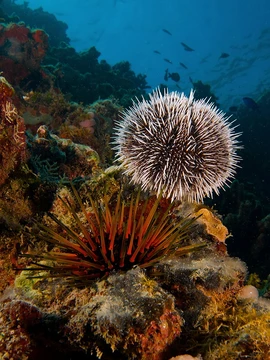
A sea urchin is a spiny, roughly spherical marine animal in the class Echinoidea, part of the broader echinoderm family that also includes starfish and sand dollars. Its body is built around a hard internal shell (the test) and covered in hundreds of thin, movable spines that it can extend or retract.
Where do sea urchins live in the wild?
They occupy virtually every ocean basin, from sunlit intertidal rocks down to abyssal plains beyond 4,000 meters. You'll most often encounter them clustered on kelp beds, rocky reefs, and sandy seabeds in both tropical and polar waters.
What's on their menu?
The vast majority are herbivorous grazers that use a remarkable five-toothed jaw apparatus called Aristotle's lantern to scrape algae, seagrass, and detritus off surfaces. A smaller number of species are carnivorous or scavenging, picking through sponges, worms, or carrion.
How do they defend themselves from predators?
Their primary weapon is a dense, radiating coat of sharp spines that makes them very difficult to swallow. Some species add mild venom to their spines, and many can regenerate lost spines or even entire body fragments over weeks to months.
How many species are there to discover?
Approximately 1,000 living species have been formally described, making Echinoidea one of the more species-rich echinoderm groups. Deep-sea expeditions in the Pacific and Atlantic continue to turn up previously unknown forms.
Why do ecologists care so much about them?
Sea urchins act as keystone grazers: by regulating algal cover they help maintain the balance of kelp forests and rocky-reef communities. When predator numbers drop, urchin populations can explode and create barren 'urchin deserts,' fundamentally reshaping the local marine landscape.
How do they reproduce?
Most species are broadcast spawners, releasing clouds of eggs and sperm into the open water during coordinated spawning events. A few brood their young on the body surface, and many can regenerate a complete individual from a small tissue fragment.
Can a sea urchin hurt a human?
They aren't aggressive, but their spines readily puncture bare skin, causing sharp pain, localized swelling, and a risk of secondary infection. A handful of tropical species deliver a mild venom, and the long spines of deep-water species can produce deep puncture wounds that may need medical attention.
How long can one of them live?
Lifespan ranges from just a couple of years in small tropical species to well over 50 years in larger temperate and deep-sea urchins. Some individuals in protected marine reserves have been documented surviving several decades, growing incrementally year after year.
How are sea urchins related to starfish and sand dollars?
All three share the phylum Echinodermata, meaning they descended from a common ancestor characterized by pentaradial symmetry and a calcite-based internal skeleton. Sea urchins and sand dollars are especially close cousins within the same class (Echinoidea), differing mainly in body shape and spine structure.