Holothuroidea
Benthic marine detritivores with a leathery skin and elongated body.

Sea cucumbers are echinoderms from the class Holothuroidea. They are benthic marine animals found on the sea floor worldwide, serving a useful role in the marine ecosystem as detritivores who help recycle nutrients. They are named for their overall resemblance to the fruit of the cucumber plant, having a leathery skin and an elongated body containing a single, branched gonad.
Quick Facts
- Taxon
- Holothuroidea
Facts from the source article.
Lore & Background
Sea cucumbers have a soft and cylindrical body, rounded off and occasionally fat in the extremities, and generally without solid appendages. Their shape ranges from almost spherical for 'sea apples' (genus Pseudocolochirus) to serpent-like for Apodida or the classic sausage-shape, while others resemble caterpillars. The mouth is surrounded by tentacles, which can be pulled back inside the animal. Most possess five rows of tube feet, but Apodida lacks these and moves by crawling. A remarkable feature is the 'catch' collagen that forms their body wall, which can be loosened and tightened at will, allowing the animal to squeeze through small gaps. The most common way to separate the subclasses is by looking at their oral tentacles: Order Apodida have up to 25 simple or pinnate oral tentacles; Aspidochirotida have 10 to 30 leaflike or shield-like oral tentacles; Dendrochirotida are filter-feeders with eight to 30 branched oral tentacles.
Reader's Guide
Sea cucumbers are notable for their role in marine ecosystems as detritivores, breaking down detritus and other organic matter so that microbes can continue the decomposition process. Many species are foraged as food by humans, and some species are cultivated in aquaculture systems. They are considered a delicacy seafood, especially in Asian cuisines, and the harvested product is variously referred to as trepang, namako, bêche-de-mer, or balate. Anatomically, they lack the arms found in many other echinoderms, and their body plan is radially symmetrical along its longitudinal axis with weak bilateral symmetry. They have no true brain, but a ring of neural tissue surrounds the oral cavity. Most sea cucumbers have no distinct sensory organs, though members of the Apodida order possess statocysts, and some species have small eye-spots near the bases of their tentacles. They use cloacal respiration via a pair of 'respiratory trees' that branch in the cloaca just inside the anus, drawing water in through the anus to extract dissolved oxygen. Together with the intestine, the respiratory trees also act as excretory organs.
Did You Know?
- Sea cucumbers have a 'catch' collagen that can loosen and tighten at will, allowing them to liquefy their body to squeeze through small gaps.
- The largest sea cucumber species, Synapta maculata, can reach more than 3 metres (9.8 ft) in length.
- Sea cucumbers breathe by drawing water in through the anus and extracting dissolved oxygen via respiratory trees.
- The harvested product of sea cucumbers is known as trepang, namako, bêche-de-mer, or balate.
Global Diversity and Morphological Range
Sea cucumbers represent a remarkably diverse class within the echinoderm phylum, with approximately 1,786 recognized species inhabiting sea floors across every ocean on Earth. The Asia-Pacific region harbors the greatest concentration of holothuroid biodiversity. Their physical forms defy a single template: some species, like the sea apples of genus Pseudocolochirus, are nearly spherical, while others in the order Apodida stretch into serpent-like forms, and still others maintain the classic elongated sausage shape that gives the group its common name. Size variation is equally dramatic—the smallest known species, Rhabdomolgus ruber, measures only a few millimetres, whereas Synapta maculata can exceed three metres in length. The largest American species, Holothuria floridana, reaches 25 to 30 centimetres and holds a volume well over 500 cubic centimetres, thriving just below the low-water mark on Florida reefs. Despite this staggering range of shapes and sizes, all share the fundamental echinoderm body plan, modified into a soft, cylindrical form without the rigid arms characteristic of their starfish and sea urchin relatives.
The Architecture of a Soft-Body Echinoderm
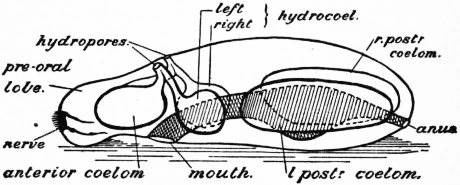
At first glance, sea cucumbers bear little resemblance to other echinoderms. Their leathery, cylindrical bodies lack visible hard parts or appendages, and the classical fivefold radial symmetry of the phylum is compounded by a bilateral symmetry that makes them appear almost chordate. Yet structural traces of pentaradiality remain: five ambulacral grooves run the length of the body, bearing rows of tube feet (podia) that attach along five internal radii stretching from mouth to anus. The ventral face, carrying three rows of podia, is termed the trivium, while the dorsal face with two rows is called the bivium. The skeleton, when present, is reduced to microscopic calcareous ossicles embedded in connective tissue, though some species enlarge these into flattened armour-like plates. In certain abyssal and pelagic forms, such as Pelagothuria natatrix, the skeleton is entirely absent. Perhaps most striking is the catch collagen in the body wall, which can be loosened to let the animal liquefy and pour through narrow crevices, then re-tightened to restore rigidity once safely lodged.
Ecological Function and Feeding Strategies
Sea cucumbers occupy a critical niche as benthic detritivores, serving as nature's recyclers on the seafloor. They break down accumulated organic matter and detritus, making nutrients available for microbial communities to continue the decomposition cycle. This role positions them as essential engineers of marine sediment health across the globe. Their feeding apparatus varies considerably among subclasses. The order Apodida, which lacks tube feet entirely, employs up to 25 simple or pinnate oral tentacles. Aspidochirotida, the most commonly encountered group, deploys 10 to 30 leaflike or shield-shaped tentacles around the mouth. Dendrochirotida, by contrast, are filter-feeders with plump bodies and eight to 30 highly branched, arborescent tentacles that can be extremely long and complex. These tentacles are in fact modified tube feet, retractable into the mouth, and in some species they are so elaborate they form intricate branching structures. The mouth sits at the anterior end of the cylindrical body, while the anus is positioned postero-dorsally.
A Delicacy Across Cultures
For centuries, sea cucumbers have been harvested as a prized seafood, particularly within Asian culinary traditions where they are regarded as a delicacy. The prepared product goes by several names depending on the culture and region: trepang, namako, bêche-de-mer, or balate. This widespread human foraging has, in some cases, prompted the development of aquaculture systems in which selected holothuroids are farmed deliberately. The culinary appeal lies in the animal's soft, leathery body, which after processing yields a texture and flavour distinct from other marine foods. The sheer number of species available—nearly 1,800 worldwide—means that different regions have developed preferences for particular forms, from the plump, branched-tentacled dendrochirotids to the more robust aspidochirotids. Whether gathered from the wild sea floor or raised in controlled aquaculture, sea cucumbers continue to bridge the gap between marine ecology and human food culture, a connection that spans from the Asia-Pacific coasts, where biodiversity peaks, to markets on every continent.
Frequently Asked Questions
Who is Holothuroidea?
Holothuroidea is a class of echinoderms made up of benthic marine animals that inhabit the sea floor across every ocean. They are instantly recognizable by their leathery skin and elongated, cucumber-like body shape.
What is Holothuroidea's role in the ecosystem?
These animals function primarily as detritivores, breaking down decaying organic material on the seafloor. In doing so, they play a critical part in recycling nutrients back into the marine food web.
How big can Holothuroidea get?
Most species fall in the 10-to-30-centimetre range, but the class spans an enormous size spectrum—from the 3-millimetre Rhabdomolgus ruber up to the over-3-metre Synapta maculata.
Where is Holothuroidea most diverse?
Roughly 1,786 species are known worldwide, and the highest concentration of that diversity is found in the Asia–Pacific region.
What does Holothuroidea look like on the inside?
Beneath the leathery exterior, each animal houses a single, branched gonad within its elongated body cavity. The overall resemblance to the fruit of the cucumber plant is what inspired the common name.
More in Sea Cucumbers and Brittle Stars 1-24
Spotted an error? Know more?
Reader corrections go straight into our review queue. Suggest an edit · How this site is sourced