Dendrochirotida
Sea cucumbers with branched tentacles and suspension-feeding habits.

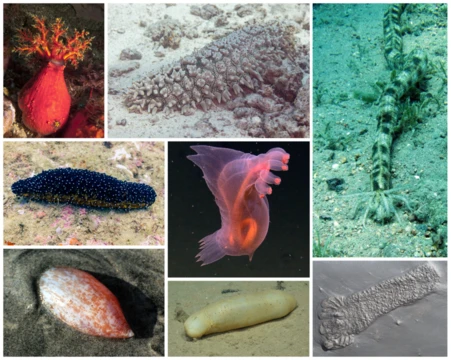
Dendrochirotida is an order of sea cucumbers. These animals have branched tentacles and feed by filtering particles from the water. Thyonella and Cucumaria are two examples.
Members of this order possess ten to thirty highly branched tentacles, which may also be finger-like. A ring of ten calcareous plates surrounds the pharynx. They have retractor and introvert muscles, allowing them to pull the tentacles back into the mouth when they are not feeding. The body wall can be firm, containing large ossicles, or soft with few ossicles. Some species attach to hard surfaces, while others burrow into soft sediment. They capture prey with sticky tentacles and move it to the mouth. Their larvae are lecithotrophic, meaning they do not feed on plankton but rely on nutrients within the egg until they settle and become juveniles.
Quick Facts
- Taxon
- Dendrochirotida
Facts from the source article.
Lore & Background
Holothurians in this order are characterised by ten to thirty much branched tentacles which are sometimes digitate. They also have ring structures composed of ten calcareous plates circling the pharynx. They have both retractor and introvert muscles which means they can retract the tentacles into the mouth when not feeding. The body wall is either firm with large ossicles or of a soft consistency with few ossicles. In some genera the animals attach themselves to hard surfaces but in others they burrow into soft sediments. Prey is captured by the sticky tentacles and transferred to the mouth. The larvae are lecithotrophic, not feeding on plankton but surviving only on materials already present in the eggs until they settle and become juveniles.
Reader's Guide
Dendrochirotida are an order of sea cucumbers distinguished by their branched tentacles and suspension-feeding lifestyle. Their ability to retract tentacles using retractor and introvert muscles is a key adaptation for protection. The order includes diverse families such as Cucumariidae, Phyllophoridae, and Psolidae, among others. Their body wall varies from firm with large ossicles to soft with few ossicles, reflecting different ecological strategies—some attach to hard surfaces, others burrow into soft sediments. The lecithotrophic larvae, which do not feed on plankton but rely on egg yolk, represent a notable reproductive trait. Examples like Thyonella and Cucumaria illustrate the group's typical morphology. The order's fossil family Monilipsolidae indicates a long evolutionary history. Overall, Dendrochirotida contribute to benthic marine ecosystems as suspension feeders, and their varied forms and behaviors highlight the adaptive diversity within sea cucumbers.
Did You Know?
- Dendrochirotida have ten to thirty much branched tentacles that are sometimes digitate.
- Their larvae are lecithotrophic, surviving on materials in the eggs until settlement.
More in Sea Cucumbers and Brittle Stars, Part 2 1-24
Spotted an error? Know more?
Reader corrections go straight into our review queue. Suggest an edit · How this site is sourced