Borani (tribe)
A tribe of debated origin that raided Roman territories in the 3rd century.
Last updated
The Borani were a tribe of debated ethnicity, probably Sarmatian or Scythian, who dwelt on the Ister. They are mentioned by the Greek historian Zosimus alongside the Goths, Carpi, and Urugundi, and also by St. Gregory Thaumaturgus. Their raids in the mid-3rd century CE contributed to widespread disruption across the Roman Balkans and Asia.
Quick Facts
- First recorded
- 250 CE
- Region
- Ister (Danube)
- Associated tribes
- Goths
- Carpi
- Urugundi
- Notable campaign
- Crossed the Cimmerian Bosporus in 256 or 257 CE
Facts from the source article.
History
The Borani first appear in historical records when they crossed the Danube and raided Moesia in the summer of 250 CE, alongside allied tribes including the Goths led by Cniva and the Carpi, though their specific role is unclear. In 251 CE, the Goths, Borani, Urugundi, and Carpi terrorized the Roman Balkans and laid waste to lands up to the sea, later taking advantage of Trebonianus Gallus' inability to defend the empire by plundering Roman cities and crossing into Asia to raid Cappadocia, Pessinus, and Ephesus.
In 253 CE, Aemilianus, commander of the Pannonian or Moesian legions, boosted troop morale, surprised the invading tribes, and defeated them, leading his army to proclaim him emperor. Later that year, the tribes endangered Thessalonica, prompting the Athenians to rebuild walls destroyed by Sulla and the Peloponnesians to fortify their isthmus. In 256 or 257 CE, the Goths, Urugundi, Carpi, and Borani pillaged Italy and Illyricum without opposition.
According to Zosimus, in 256 or 257 CE the Borani crossed the Cimmerian Bosporus into Asia, aided by the Bosporan Kingdom out of fear, while St. Gregory Thaumaturgus also notes the Goths raided. The movement of the Borani and Goths caused many Black Sea coast inhabitants to flee to Roman forts. The Borani and Goths sailed to Pityus, a remote Roman-controlled Caucasian city, but were driven back with heavy losses by the general Successianus, after which they withdrew fearing further Roman reinforcements.
Ethnicity and connections to other tribes
The most common theory among western historians identifies the Borani as a Scytho-Sarmatian tribe. William Smith and Johann Kaspar Zeuß equated them with the Bulanes, a tribe east of the Vistula near the Gutones, though Smith noted a possible connection to the Selonians or Polans depending on manuscript readings. Some scholars linked the Bulanes to Ptolemy's Borusci, leading Uldastov to propose a Slavic origin for the Borani, an idea popular in the early 20th century.
Remennikov also favored a Slavic origin but suggested connections with the Germanic Buri or the Bulanes, while considering them Scythian, Sarmatian, Alanic, or Slavic. Gapusenko linked the Borani to the Polans and Borusci, and Pioro identified them with the Germanic Varini, an identification seen as both unlikely and promising. Vasiliev argued the name derived from the Scandinavian word Vaeria, meaning to protect or defend, and proposed the Borani were Germanic guards of the Bosporan Kings.
Levada suggested they were Batavians, based on Ammianus' report that Batavians and Herulians acted together, while Shchukin supported connections with both the Buri and Varini. Moritz Schönfeld considered them a non-Germanic people with a non-Germanic name. Another theory holds that the name means 'people from the north' and refers to newly arrived Goths and possibly Heruli, though St. Gregory Thaumaturgus differentiates them.
Location
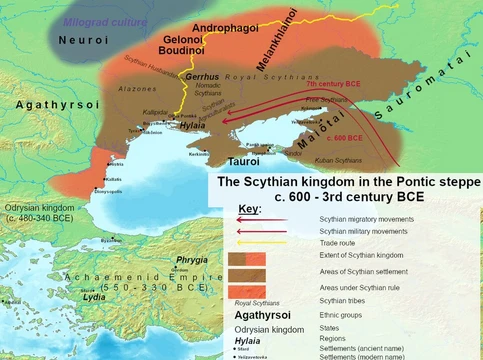
Johann Kaspar Zeuß placed the Borani originally between the Bug and the Vistula alongside the Amadoci and Costobocci, before they migrated south to the coast with the Goths, based on equating them with Ptolemy's Bulanes. Other sources locate them southwest of the Carpi on the northeastern bank of the Danube, consistent with Zosimus' statement that they dwelt along the Ister. Scheel Philologus places them south of the Buri, while another theory situates them in Southern Russia or Ukraine near the Goths, which would explain their easy access to the Bosporan Kingdom.
More in Scythia
Sources
Compiled from Wikipedia and the sources listed below. Text from Wikipedia is available under CC BY-SA 4.0; this entry is adapted from it.
- Wikipedia: Borani (tribe) (CC BY-SA 4.0).
Spotted an error? Know more?
Reader corrections go straight into our review queue. Suggest an edit · How this site is sourced