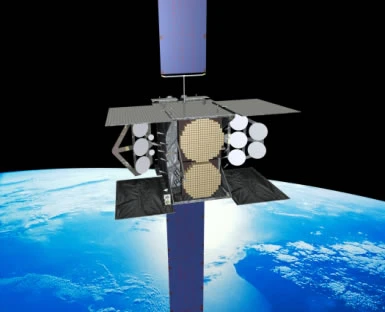
SES-9
SES-9 provides Ku-band communications over Asia and the Indian Ocean.
Last updated
SES-9 is a geostationary communications satellite operated by SES. It was launched from Cape Canaveral SLC-40 by a Falcon 9 Full Thrust launch vehicle on 4 March 2016.
Satellite description
SES-9 operates in geostationary orbit at 108.2° East, serving Northeast Asia, South Asia, Indonesia, and maritime users in the Indian Ocean, along with mobility beams for in-flight connectivity for airlines in Indonesia and the Philippines. Built by Boeing on a BSS-702HP bus, it had a launch mass of 5271 kg, the heaviest Falcon 9 payload to a geosynchronous transfer orbit at that time. The satellite used its own propulsion to reach geostationary orbit.
Market and coverage
SES-9 carries 57 high-power Ku-band transponders, equivalent to 81 transponders of 36 MHz bandwidth. Co-located at 108.2°E with SES-7, it supplies additional and replacement capacity for DTH broadcasting and data in Northeast Asia, South Asia, and Indonesia, plus maritime communications for the Indian Ocean. Its six Ku-band beams include: a South Asia beam centred on India with a 55 dBW signal (40 cm dish) covering Pakistan, Bangladesh, Sri Lanka, Nepal, and parts of Myanmar; a Northeast Asia beam centred on the Philippines with a 55 dBW signal (40 cm dish) covering eastern China and parts of Indonesia; a Southeast Asia beam centred on Indonesia with a 54 dBW signal (45 cm dish) covering Malaysia, Singapore, and parts of Papua New Guinea; a West Indian Ocean beam centred on the Gulf of Oman with a 53 dBW signal (50 cm dish) covering the Arabian Peninsula, East Africa, and western India and Pakistan; an East Indian Ocean beam centred on the Bay of Bengal with a 54 dBW signal (45 cm dish) covering southern and eastern India, Sri Lanka, and parts of Bangladesh, Myanmar, Thailand and Malaysia; and an Australia beam centred on Adelaide with a 55 dBW signal (40 cm dish) covering South Australia and parts of Western Australia, Northern Territory, New South Wales and Victoria.
Launch operations
SES contracted SpaceX for three launches starting with SES-9, announced on 12 September 2012, following the earlier SES-8 mission. In early 2015, SES became the launch customer for the Falcon 9 v1.1 Full Thrust (also called Falcon 9 v1.2, later Falcon 9 Full Thrust), expecting launch by September 2015. After the CRS-7 failure in June 2015, SES re-confirmed in September 2015 its decision to provide the first payload for the new rocket variant, but the launch was postponed.
On 16 October 2015, SpaceX announced that Orbcomm's 11 Orbcomm-OG2 satellites would fly on the return-to-flight mission instead, as their lower orbit allowed testing of second-stage engine relighting needed for the heavier SES-9. The Orbcomm mission was delayed to mid-December 2015, with SES-9 to follow within weeks. The Falcon 9 Full Thrust maiden launch occurred on 22 December 2015, the final Falcon 9 v1.1 launch in January 2016, and SES-9 moved to February 2016, becoming the second Full Thrust launch.
A successful static fire test was completed on 22 February 2016. The launch was initially scheduled for 24 February 2016 at 23:46 UTC, with a backup window the next day. Both attempts were scrubbed: on 24 February, prior to propellant loading, out of caution to cool the liquid oxygen as much as possible; and on 25 February, two minutes before launch due to a last-minute propellant loading problem.
More in Satellites Using the BSS-702 Bus
Sources
Compiled from Wikipedia and the sources listed below. Text from Wikipedia is available under CC BY-SA 4.0; this entry is adapted from it.
- Wikipedia: SES-9 (CC BY-SA 4.0).
Spotted an error? Know more?
Reader corrections go straight into our review queue. Suggest an edit · How this site is sourced