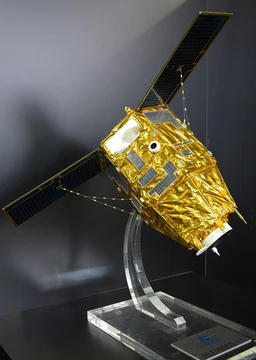
Ariane flight V88
Maiden Ariane 5 flight destroyed by software error.
Ariane flight V88, the maiden flight of the Ariane 5 rocket, ended in failure on 4 June 1996. The launch carried the Cluster constellation of four European Space Agency research satellites. The failure became one of the most infamous and expensive software bugs in history, resulting in a loss of more than US$370 million.
Quick Facts
- Rocket
- Ariane 5G
- Launch
- 4 June 1996, 12:34:06 UTC
- Operator
- Arianespace
- Payload
- Cluster
- Outcome
- Failure
- Duration
- 37 seconds
- Serial
- 501
Facts from the source article.
Did You Know?
- The four spacecraft were intended to fly in a tetrahedral formation to research Earth's magnetosphere.
- The planned orbit was highly elliptical: 17200 by 120600 km, inclined at 90 degrees to the equator.
Launch failure
The Ariane 5's flight software came from the Ariane 4's inertial reference system, but the newer rocket's early trajectory had much higher horizontal speeds. This made a calculated value called BH, or Horizontal Bias, climb far beyond normal levels. The alignment function that produced BH ran for about 40 seconds after launch—a leftover from Ariane 4 requirements—even though it did nothing useful once the Ariane 5 was airborne. The extreme BH value caused a conversion from a 64-bit floating point number into a 16-bit signed integer to fail, triggering a hardware exception.
Programmers had only shielded four of seven critical variables from overflow to keep the onboard computer's workload under an 80% limit; the three unprotected ones relied on assumptions about possible values that held true for Ariane 4 but not for Ariane 5. The exception shut down both inertial reference system modules, even though they were meant to back each other up. The active module sent a diagnostic bit pattern to the main onboard computer, which the computer misread as real flight data.
This commanded the solid boosters and the Vulcain main engine to deflect their nozzles fully. The resulting angle of attack exceeded 20 degrees, causing the boosters to separate from the main stage, which then triggered the launcher's self-destruct system and destroyed the flight.
Aftermath
Four replacement Cluster II satellites were built and launched in pairs aboard Soyuz-U/Fregat rockets in 2000. The failure drew public, political, and executive attention to the high risks of complex computing systems, increasing support for research into safety-critical system reliability. The subsequent automated analysis of the Ariane code, written in Ada, was the first large-scale static code analysis by abstract interpretation. The failure damaged the excellent success record of the European Space Agency's rocket family, set by the Ariane 4; Ariane 5 launches were not recognised as equally reliable until 2007.
More in Satellite Launch Failures
Spotted an error? Know more?
Reader corrections go straight into our review queue. Suggest an edit · How this site is sourced