Tula Oblast
A historically rich industrial and agricultural region in European Russia, home to the Tula Kremlin and Yasnaya Polyana.
Last updated
Metalworking, engineering, coalmining, and chemical industries are prominent in this industrial center, with Novomoskovsk and Aleksin as major industrial cities.[1] Grain farming (wheat and rye), potato and sugar beet cultivation, vegetable growing, livestock raising, and dairying are all part of the oblast's agricultural sector, which ranks 33rd in Russia for agricultural production.[2]
Geography and history
The oblast is rich in iron ore, clay, limestone, and deposits of lignite coal, which is part of the Moscow coal basin.[3] Vital statistics for 2024 recorded 8,851 births and 22,324 deaths.[4] Burial mounds (kurgans) and old settlements discovered in the Tula Oblast area provide evidence of habitation since the Stone Age.[5] The Vyatichi, an East Slavic tribe, occupied these lands by the eighth century; they engaged in cultivation, trade, and crafts, as recorded in property registers mentioning an "ancient settlement" at the confluence of the Upa and Tulitsa rivers.[5]
The Nikon Chronicle contains the earliest reference to the city of Tula, dating to 1146, in connection with a campaign by Prince Svyatoslav Olgovich of Chernigov.[2]
What the cited sources add
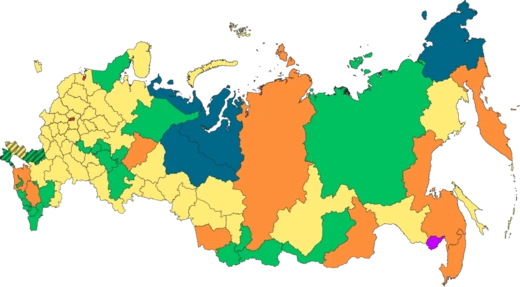
The 2012 Arena survey, conducted by research organization Sreda with field work by the foundation “Public Opinion” MegaFOM, sampled 56,900 respondents covering 98.8% of the Russian Federation population.[6]
References
- Wikipedia, "Tula Oblast" (CC BY-SA 4.0), which cites: "Tula", Encyclopædia Britannica Online (original not read by us) en.wikipedia.org
- Wikipedia, "Tula Oblast" (CC BY-SA 4.0), which cites: "Tula Region", Kommersant Moscow, 8 March 2004 (original not read by us) en.wikipedia.org
- Wikipedia, "Tula Oblast" (CC BY-SA 4.0), which cites: "Tula Oblast", Merriam-Webster's Geographical Dictionary (2001), January 2021 (original not read by us) en.wikipedia.org
- Wikipedia, "Tula Oblast" (CC BY-SA 4.0), which cites: "Естественное движение населения в разрезе субъектов российской федерации за декабрь 2024 года", Rosstat, 21 February 2025 (original not read by us) en.wikipedia.org
- Wikipedia, "Tula Oblast" (CC BY-SA 4.0), which cites: Yushkova, "Local Societies in Bronze Age Northern Europe", Equinox (Acumen), 2012, p. 129–147 (we also read that source) en.wikipedia.org
- "Arena: Atlas of Religions and Nationalities in Russia". Sreda, 2012.. facts only, no text reused. sreda.org
Each numbered sentence above was checked against the source it cites before publication. Sentences citing Wikipedia adapt text from the English Wikipedia article Tula Oblast (contributors), used under CC BY-SA 4.0; this entry is available under the same licence. Other sources were used for facts only; no text or images are copied from them.
More in Russian Regions
Sources
Compiled from Wikipedia and the sources listed below. Text from Wikipedia is available under CC BY-SA 4.0; this entry is adapted from it.
- Wikipedia: Tula Oblast (CC BY-SA 4.0).
Spotted an error? Know more?
Reader corrections go straight into our review queue. Suggest an edit · How this site is sourced