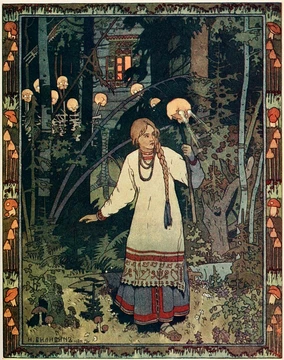
The Magic Swan Geese
A girl rescues her brother from Baba Yaga with help from nature.
The Magic Swan Geese is a Russian fairy tale collected by Alexander Afanasyev in his Narodnye russkie skazki, where it appears as number 113. It is classified in the Aarne–Thompson–Uther Index as tale type ATU 480A.
Quick Facts
- Atu type
- ATU 480A
- Collector
- Alexander Afanasyev
- Collection
- Narodnye russkie skazki
- Number in collection
- 113
Facts from the source article.
Synopsis
A brother and sister were left at home while their parents were away. The older sister was supposed to watch her little brother, but she got distracted and lost him. Magical swan geese carried him off. She ran after them and met an oven that offered to help if she ate its rye buns. She refused, saying she would not even eat wheat buns. She also turned down an apple tree and a river of milk that made similar offers. Eventually she found a tiny hut standing on a chicken leg. Inside was Baba Yaga with her brother. The witch ordered the girl to spin flax and then left. A mouse appeared and promised to share a secret if given porridge. The girl fed it, and the mouse warned that Baba Yaga was heating the bathhouse to steam her and then cook her. The mouse took over the spinning, and the girl grabbed her brother and escaped. Baba Yaga sent the swan geese after them. The girl begged the river for shelter. The river made her drink first, and when she did, it hid them. The geese found them again, and the same thing happened with the apple tree and the oven. After each one helped her, she finally made it home safely with her brother.
Analysis
The tale is classified in the Aarne–Thompson–Uther Index as type ATU 480A, Three Sisters Set Out to Save Their Little Brother. German scholar Hans-Jörg Uther, in his 2004 revision of the ATU index, reported variants from Latvia, Lithuania, Russia, Belarus, Ukraine, and among the Mari/Cheremis and Wotian/Syrjanien peoples. Jack Haney stated that type 480A seemed to appear very rarely outside the area of the East Slavic languages. The story is classified in the East Slavic Folktale Classification (СУС), last updated by scholar Lev Barag in 1979, as type SUS 480A, Сестра (три сестры) отправляется спасать своего брата. According to the catalogue, the type is reported in Russia, Ukraine and Belarus. The oldest attestation of the tale type in Russia appears in a late-18th century publication, with the tale Сказка о Сизом Орле и мальчике (The Fairy Tale about the Blue Eagle and the Boy). Lithuanian folklorist Jonas Balys, in his analysis of Lithuanian folktales published in 1936, previously classified the Lithuanian variants as 314C, Trys seserys gelbsti raganos pavogtą broliuką. According to Stith Thompson's reworked folktale classification published in 1961, tale type AaTh 480A registered 30 variants in Lithuania. A similar story is found in Latvia, also classified as type AaTh 480A, Bārenīte pie raganas (The Orphan in the Witch's House): the heroine's little brother is taken by the witch to her lair, the heroine's sisters try to get him back and fail, the heroine herself is kind to objects on her way to the witch, rescues her little brother and the objects protect her when the witch goes after her. The tale type ATU 480A is also reported in Estonia, with the title Kured viivad venna ära (The Cranes Take the Brother Away); in the Estonian variants, the heroine's little brother is taken away by cranes or geese. Scholar S. S. Sabitov located a similar narrative in the Catalogue of Tales of Magic from the Mari people, indexed as type 480A, Сестра отправляется спасать своего брата (Sister races to save her brother): the heroine treats objects and trees with respect, which protect her when she escapes with her brother from the witch Vuver-kuva and her geese.
More in Russian Fairy Tales
Spotted an error? Know more?
Reader corrections go straight into our review queue. Suggest an edit · How this site is sourced