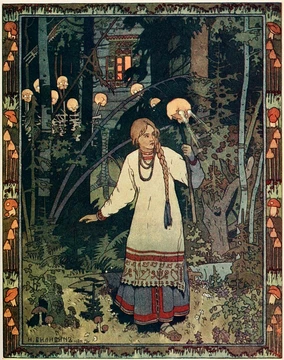
The Girl as Soldier
A disguised heroine faces gender tests and witch-imposed tasks.
A Russian folktale collected by Ivan Khudyakov, "The Girl as Soldier" was originally called "Опять Сноха" ("The Daughter-in-Law, Again"). In the story, a heroine dresses as a man, survives tests meant to reveal her sex, and is later abducted by her lover or his mother. The mother then forces the heroine to complete difficult chores.
Quick Facts
- Original title translation
- The Daughter-in-Law, Again
- Collector
- Ivan Khudyakov
- German title
- Das Mädchen als Soldat
- East slavic tale type
- SUS 428
- Number of registered variants
- 12
Facts from the source article.
Summary
A man with three daughters is called to war. His youngest daughter volunteers to take his place, dressing as a male soldier. She joins the army and is billeted with a fellow soldier and his mother. The mother suspects the friend is a woman and devises tests: first, the girl must sleep on grass, where the imprint of her body would reveal her sex; second, she must bathe in a sauna with the soldier. The girl tricks the soldier into fetching soap and bathes first. When the war ends, she returns home. Later, the soldier appears at her house in the form of a cat, carries her on his back across the Oka River to his mother. The girl throws her ring into the water, vows never to speak to the soldier's parents, and marries him. The mother-in-law then sets dangerous tasks: shear her gray sheep (actually gray wolves), milk her brown cows (actually bears), and fetch a reed from her "sister." The husband warns that this "sister" is the witch Baba Yaga, who will eat her, and gives her butter, a comb, and a brush. The girl goes to Baba Yaga's hut on chicken legs and asks for the reed. Baba Yaga goes to sharpen her teeth. The girl gives the butter to a cat, which advises her to spit under the porch so her saliva can answer for her, then take the reed and flee. She does so, escaping as Baba Yaga chases in her iron mortar. The girl throws the comb and brush behind her, creating obstacles. After she delivers the reed, the mother-in-law accepts that her daughter-in-law has survived. Finally, the girl retrieves her ring from the river.
Analysis
Russian scholarship classifies the tale as type SUS 428, "Девушка на службе у ведьмы" ("The Girl in the Witch's Service"), of the East Slavic Folktale Classification. According to scholars Andreas John and Lev Barag, in the East Slavic type the heroine's mother-in-law (sometimes identified as the witch Baba Yaga) sends her on dangerous tasks to get rid of her, but with her husband's advice she prevails: she milks cows (bears), shears sheep (devils), and visits a second witch in the other world by treating objects with kindness. Swedish scholar Jan-Öjvind Swahn acknowledged that Russian type 428 was subtype 425A of his analysis, that is, "Cupid and Psyche," being the "oldest" and containing the witch's tasks episode; in the international index, Swahn's typing is indexed as type ATU 425B, "The Son of the Witch." Felix Karlinger considered the tale a combination of heterogeneous subjects: the girl as soldier and the demonic mother-in-law. Jan-Öjvind Swahn surmised that in Slavonic tradition, tales of type Aa 428 involve a sequence named "The Girl as a Soldier" or "The Girl At War," wherein the heroine wears a male disguise, joins a compatriot who tries to unmask her gender, and eventually marries him, then the tale segues into her mother-in-law's attempts to kill her by setting ludicrous tasks. The East Slavic Folktale Index classified this sequence as tale type SUS 884B, "Василиса-поповна" ("Vasilisa-popovna").
Variants
According to the East Slavic Folktale Catalogue, which folklorist Lev Barag last updated in 1979, only twelve versions of this story have been recorded. Scholars in both Karelia and Russia consider this low number a sign that the tale type is rare. One Russian version, collected by E. A. Chudinsky in the Makaryevsky Uyezd area of Nizhny Novgorod Governorate, is called "Vasilisa Vasilievna." In it, a master, or barin, has three daughters, while the witch Baba Yaga has a son named Vasily Vasilyevich. When the master is called to war, his youngest daughter, Vasilisa Vasilievna, takes his place by disguising herself as a man. She serves alongside Vasily, and the two become friends. Vasily later visits his mother, Baba Yaga, who suspects that his companion is actually a woman. Though Vasily doubts her, he agrees to test the friend's gender. First, Baba Yaga gives Vasily embroidered silks to show Vasilisa, but she dismisses them and asks to see the horses instead. Next, Baba Yaga heats the bathhouse and tells Vasily to invite his friend for a steam bath. Vasilisa insists on bringing her dog, lets the dog answer for her, and escapes. Unable to find her, Vasily returns to his mother, who devises a plan to capture her: they carve pigeons, paint them, and take them to market. Meanwhile, Vasilisa sheds her disguise and returns to her female identity. Her father asks what gifts his three daughters want from the market. The eldest asks for silk, the middle for gold, and Vasilisa asks for something that will make people marvel. The father buys silk, gold, and the painted pigeons as a reward for Vasilisa's service in the war. The pigeons coo that they will carry her back to Baba Yaga, but Vasilisa falls asleep and does not hear them. After three coos, the pigeons lift her away to Baba Yaga, who marries her to Vasily. Baba Yaga then tries repeatedly to destroy Vasilisa, but fails. Vasilisa throws birch bark on the ground and says that when it becomes a forest, she will live happily with her husband. The bark instantly turns into a forest, and Vasilisa and Vasily live happily ever after.
More in Russian Fairy Tales
Spotted an error? Know more?
Reader corrections go straight into our review queue. Suggest an edit · How this site is sourced