Storm-Bogatyr, Ivan the Cow's Son
A hero born of a cow battles serpents on the Kalinov Bridge.
"Storm-Bogatyr, Ivan the Cow's Son" is a Russian fairy tale collected by Alexander Afanasyev as tale number 136 in his mid-19th-century collection. It is classified as Aarne-Thompson type 300 A and 519. Alternative English titles include "Blast Bogatyr Ivan the Cow's Son" and "Ivan the Cow's Son".
Quick Facts
- Afanasyev tale number
- 136
- Aarne-thompson type
- 300 A and 519
- Collection
- Narodnye russkie skazki
- Recorded location
- Orenburg guberniya
- English translations
- Jack V. Haney (2014)
- Sergei Levchin (2014)
- Norbert Guterman (1946)
Facts from the source article.
General information
The tale appears as number 136 in Alexander Afanasyev's mid-19th-century collection Narodnye russkie skazki. It was recorded in the Orenburg guberniya. The tale is categorized as Aarne-Thompson type 300 A and 519.
Synopsis
Three Ivans are born on the same day: the cow's son, the prince, and a maidservant's son. The king, seeking to make his childless queen pregnant, issued a worldwide plea. A peasant's son, guided by a wise old hag, gave the king a gold-winged pike netted near the palace. The cow that drank slop water from the fish's cleaning, the servant-girl who tasted the fish, and the queen who ate the dish all conceived. The three boys grew with extraordinary speed. When of age, they asked the king to journey. They held a contest throwing a glass marble to choose a senior; Ivan the Cow's Son, called Storm-Bogatyr, won. A rematch involved making the Black Sea serpent stop clucking; only Storm-Bogatyr succeeded. The other two Ivans were dissatisfied and parted ways. Storm-Bogatyr returned alone and was thrown into the fortress without food for three days. He demanded explanation, threatening to break the walls. The king visited, and Ivan said the other sons were alive but had gone where three serpents with six, nine, and twelve heads emerge from the Black Sea. Storm-Bogatyr claimed only he could track them, and at the king's request he pursued them, armed with his battle club and magic sword (Sword Kladenets). He then defeated the three water-dragons.
Magical elements
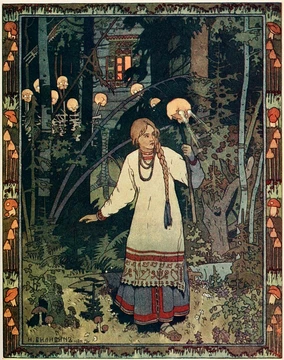
Near the monsters' location, the three brothers find a hut on chicken legs with a rooster's head, facing the forest. Inside, a table is set with food and drink, and a bed is ready. This hut is familiar as the abode of Baba Yaga. After battling the twelve-headed monster, the hut breaks into bits but repairs itself at Storm-Bogatyr's command. Storm-Bogatyr paces a bridge tapping it with his cane until a little pitcher appears and dances; he spits on it and smashes it, causing the Chudo-Yudo to appear. Characters can transform: the hero turns into a fly and a falcon; Baba-Yaga transforms into a sow, identified by one researcher as an ancient avatar of the Goddess of the Underworld, and her daughters-in-law's transformations represent life and death themes. The Kalinov Bridge appears in East Slavic folklore as a liminal space crossing a swamp or fiery river named Smorodina, where the hero battles villains like Chudo-Yudo or Zmei Gorynych. The name "Kalinov" has been interpreted as meaning "blazing" or "incandescent" (if made of iron) or as a type of tree or flower such as the guelder-rose. Stories of a hero fighting a villain on a bridge are common in East Slavic folklore.
More in Russian Fairy Tales
Spotted an error? Know more?
Reader corrections go straight into our review queue. Suggest an edit · How this site is sourced