White and Black in chess
White moves first; colors are light and dark.
Last updated
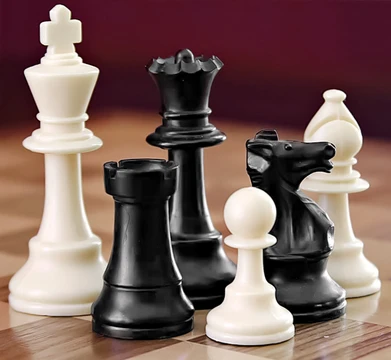
In chess, the player who moves first is called White, and the player who moves second is called Black. Their pieces and the squares on the checkered board are referred to as white and black, though they are usually contrasting light and dark colors rather than literally white and black. The terms are also used to denote the players themselves when capitalized.
Quick Facts
- White scoring range
- 52 to 56 percent
- First-move advantage debated since
- at least the 18th century
Facts from the source article.
History
Chess pieces were not always black and white. Early descriptions, like the poem Versus de scachis, mention red and white pieces instead. The board itself originally had sixty-four plain squares; the alternating light and dark pattern was a European addition from the 1200s. The rule that White moves first is surprisingly modern.
In the first edition of his famous 1749 book, François-André Danican Philidor noted a game where Black played first. A German book from 1824 by Johann Horny also stated that Black moves first. Alexander McDonnell, a leading player in the early 1800s, often chose to be Black whether he moved first or second—a common preference at the time. In the famous Immortal Game of 1851, Adolf Anderssen played Black but made the first move.
He did the same in several games of his 1858 match against Paul Morphy. As late as the mid-1800s, moving first did not automatically mean playing White. The rules of London’s St George’s Chess Club in 1841 gave the first mover the choice of color. Even in 1871, Howard Staunton remarked that many players still clung to the odd habit of always using the same color.
Did You Know?
- In old chess writings, the sides are often called Red and Black because those were the two colors of ink then commonly available when hand-drawing or printing chess position diagrams.
- For example, the squares on vinyl boards may be off-white (buff) and green, while those on wood boards are often light brown and dark brown.
More in Rules of Chess
Sources
Compiled from Wikipedia and the sources listed below. Text from Wikipedia is available under CC BY-SA 4.0; this entry is adapted from it.
- Wikipedia: White and Black in chess (CC BY-SA 4.0).
Spotted an error? Know more?
Reader corrections go straight into our review queue. Suggest an edit · How this site is sourced