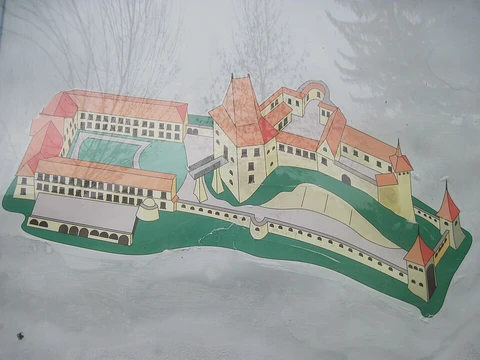
Shmankivtsi Castle
Lost pentagonal wooden castle discovered in the 1990s.
Deep in the village of Shmankivtsi, within Ukraine's Ternopil Oblast, lie the remains of a lost fortress known as Shmankivtsi Castle. Archaeologist Volodymyr Dobrianskyi uncovered the site in the early 1990s while digging in the Nichlava river basin. It now holds a spot on the list of newly discovered cultural heritage sites, designated under protection number 2088.
Quick Facts
- Location
- Shmankivtsi', Chortkiv Raion Ternopil' Oblast'
- Condition
- ruined
- Owner
- Ukraine
- Events
- Tatar invasions
Facts from the source article.
History
On November 26, 1624, Dominican monks from Chortkiv, together with Pavel Kelpinsky, a neighbor of the village of Shmankivtsi, decided to build a castle to defend against the Tatars, as well as a monastery and kindergarten in Chortkiv. The wooden castle was erected in the mid-17th century on the eastern outskirts of the village, on the corner of an elongated slope 10–15 m high on the left bank of the Nichlava River, in the Zamkova Hora tract. It was shaped as a pentagon, with a steep slope in the western part of about 60 m, where a working quarry existed until recently. An embankment was built in the eastern part; today its height is about 1 m and width up to 5 m. Inside, this shaft is flat, indicating it was an apron, and it is now escarped from the front side. Over time the land sank, but in the 17th century it was counter-scarped. Below the shaft level, at a depth of 1 m, lies a triangular platform resembling a ravelin, with two side faces 30 m long. From the north-western corner of the ravelin, a tenal passes down the slope, deepened up to 1 m into the deluvial slope; in some areas a parapet poured from above is still traceable. From the front field side, a shaft up to 100 m long connects near the ravelin with a second, raised shaft with an apron and counterscarp in the eastern part. In places the shaft reaches 0.5–0.7 m in height, and in front of it a dug ditch is visible, heavily leveled by time and deep plowing, as the area was a field until the early 1990s. The western part of the hill was destroyed by a quarry, where layers of ash and charcoal and pottery remains from the late 17th century were found, suggesting the owner's palace and outbuildings burned during an assault and siege. The entrance to the castle likely passed through a dungeon in this part, which was lost due to destruction by villagers.
More in Ruined Castles in Ukraine
Spotted an error? Know more?
Reader corrections go straight into our review queue. Suggest an edit · How this site is sourced