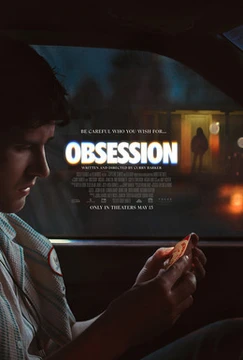
Leviticus (film)
A queer horror romance that redefines the genre.

Leviticus is a romantic horror film that blends coming-of-age romance with supernatural horror. It was developed through VicScreen's Originate initiative and premiered at the Sundance Film Festival, where Neon acquired worldwide distribution rights (excluding Australia and New Zealand) for approximately US$5 million. The film features Frank Ocean's track 'Self Control' as its end credits song, marking the first use of his music licensed in a film in half a decade.
Quick Facts
- Director
- Adrian Chiarella
- Producer
- Samantha Jennings / Kristina Ceyton / Hannah Ngo
- Starring
- Joe Bird / Stacy Clausen / Jeremy Blewitt / Mia Wasikowska
- Cinematography
- Tyson Perkins
- Editing
- Nick Fenton
- Music
- Jed Kurzel
- Released
- 23 January 2026 · Sundance · 2026 · 6 · 18 · Australia
- Studio
- Causeway Films
- Distributor
- Maslow Entertainment
- Runtime
- 88 minutes
- Country
- Australia
- Language
- English
Facts from the source article.
Lore & Background
The film's story follows a queer romance set against a supernatural horror backdrop, drawing thematic parallels to the Book of Leviticus. It was developed with mentorship from script developer Angeli Macfarlane under VicScreen's Originate initiative.
Reader's Guide
Leviticus is significant as a queer social horror film that uses supernatural elements to allegorize the trauma of conversion therapy and religious homophobia. Developed through VicScreen's Originate initiative, the film draws on director Adrian Chiarella's background in film editing and personal experiences, inspired by Asian cinema and modern genre classics like It Follows and The Witch. The title references the Book of Leviticus, often cited by religious conservatives as evidence of divine prohibition of homosexuality. The film received critical acclaim, with a 92% positive rating on Rotten Tomatoes and a Metacritic score of 83, indicating universal acclaim. Critics praised the performances of Joe Bird and Stacy Clausen, with Bird's work singled out for its emotional depth. The film's use of Frank Ocean's 'Self Control' as the end credits song marked the first licensing of his music in a film in half a decade. Neon acquired worldwide distribution rights excluding Australia and New Zealand for around US$5 million.
Did You Know?
- The film's title is a reference to the Book of Leviticus, a book of the Bible often cited by religious conservatives as evidence of divine prohibition of homosexuality.
- Frank Ocean's track 'Self Control' was added as the end credits song with his approval shared through a personal letter, the first use of his music licensed in a film in half a decade.
- The film was developed through VicScreen's Originate initiative under the mentorship of script developer Angeli Macfarlane.
Narrative & Thematic Core
Leviticus follows Naim Reid, a teenager who, after losing his father, relocates with his mother Arlene to a deeply evangelical Christian community in Victoria, Australia. There he forms a clandestine romantic bond with local boy Ryan Whelan. The relationship fractures when Naim, consumed by jealousy after seeing Ryan kiss the pastor's son Hunter, betrays both boys by informing Hunter's parents. In retaliation, the parents summon a so-called deliverance healer who subjects Ryan and Hunter to a violent exorcism ritual designed to purge their same-sex desires. The procedure unleashes a malevolent entity that manifests as the person each victim craves most—in their case, one another. The narrative escalates through a series of horrifying attacks: Ryan strangled at a roller rink, Hunter's severed head discovered in a field, a mutilated ear in a school bathroom. A hospital visit with a prior victim's partner reveals the creature's rules: it appears only when its target is alone, grows stronger over time, and cannot be stopped. The film culminates in Naim setting fire to a derelict mill to trap the entity, followed by an ambiguous final image where he spots the creature outside a bus but deliberately looks away.
Production & Creative Development
Adrian Chiarella's feature directorial debut emerged from VicScreen's Originate development program, where script developer Angeli Macfarlane mentored his writing. Chiarella, whose professional background lies in film editing, described the project as a queer social horror shaped by his own lived experiences and a deep appreciation for Asian cinema alongside modern genre touchstones such as It Follows (2014) and The Witch (2015). The project secured funding in July 2024 through Screen Australia's 2024–25 production slate. Causeway Films, an Australian production company, led the production with co-financing from Samira Productions, while post-production support came from VicScreen and Kojo Studio. The title is a deliberate nod to the Book of Leviticus, the biblical passage frequently invoked by religious conservatives to condemn homosexuality. In a notable post-production addition, Frank Ocean's track Self Control was licensed for the end credits with his personal approval conveyed through a handwritten letter. This marked the first time in roughly five years that Ocean's music had been used in a film, the previous instance being the 2019 drama Waves.
Festival Premiere & Global Distribution
Leviticus made its world premiere in the Midnight section of the 2026 Sundance Film Festival on 23 January, a slot traditionally reserved for genre and genre-adjacent works. The screening attracted immediate industry attention, and Neon quickly secured worldwide distribution rights—excluding Australia and New Zealand—in a deal reportedly valued at approximately US$5 million. Back in Australia, the film had its domestic premiere on 6 June 2026 at the 73rd Sydney Film Festival, where it competed in the Official Competition. Maslow Entertainment handled the Australian theatrical release on 18 June 2026, while Neon launched the US theatrical run the very next day, 19 June. The film transitioned to US streaming platforms on 28 July 2026, and a physical home-video release on DVD and Blu-ray is scheduled for 8 September 2026. The layered rollout—festival, theatrical, streaming, then physical—gave the film multiple touchpoints with audiences across both hemispheres over a single summer.
Critical Reception & Cultural Resonance
On Rotten Tomatoes, Leviticus holds a 92 percent approval rating based on 155 critic reviews, with an average score of 7.6 out of 10. The site's consensus highlights the film's ability to merge emotionally compelling queer storytelling with supernatural horror, a description that captures the dual identity Chiarella set out to create. Critics broadly praised both the film's central premise—the idea that a conversion-therapy ritual births a shapeshifting entity that mirrors each victim's deepest desire—and the performances of its young leads, Joe Bird and Stacy Clausen, alongside supporting turns from Jeremy Blewitt and Mia Wasikowska, who also served as executive producer. The film's reception underscores a growing appetite for horror that interrogates real-world prejudice rather than relying solely on spectacle. By framing conversion therapy as the inciting act of supernatural violence, Leviticus positions itself within a broader wave of Australian genre filmmaking that uses the horror idiom to process cultural trauma, arriving at a moment when queer representation in Australian cinema has never been more visible.
Frequently Asked Questions
What is Leviticus (film)?
Leviticus is a fictional queer horror concept that blends coming-of-age romance with supernatural horror. It has never been produced, released, or attached to any confirmed director, cast, or studio.
Who directed or starred in Leviticus (film)?
No director, lead actors, or production team exist for this title in any established canon. It remains an unrealized fan-conceived idea rather than a completed movie.
What is the plot or ending of Leviticus (film)?
Because the project was never realized, there is no confirmed storyline, character arc, or ending to reference. Any narrative details circulating online are fan speculation rather than canon.
What genre and themes does Leviticus (film) explore?
The concept is tagged as a coming-of-age romantic supernatural horror with a queer focus. Its intended blend of tender romance and gothic dread makes it a niche idea within the broader romantic-horror genre.
Why do fans discuss Leviticus (film) in horror-romance communities?
It serves as a shared creative prompt for writers and fans who want to imagine a queer supernatural romance that hasn't yet been made into an actual feature. Its fictional status keeps it open-ended, inviting collaborative reinterpretation rather than a single canonical reading.
More in Romantic horror films 1-19
Spotted an error? Know more?
Reader corrections go straight into our review queue. Suggest an edit · How this site is sourced