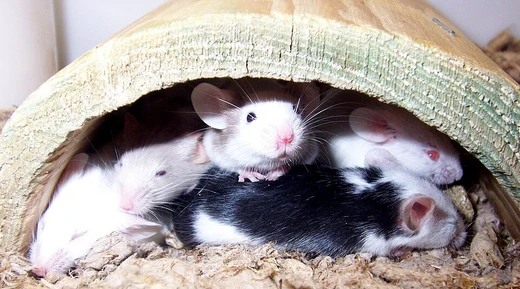
House mouse
A synanthropic rodent and key model organism in biology.

Unknown authorUnknown author (original) / Ilmari Karonen (editing) · via Wikipedia: House mouse · Public domain
The house mouse (*Mus musculus*) is a small rodent with a pointed nose, big round ears, and a long tail that is mostly bald. It belongs to the family Muridae and is one of the most common members of its genus. Though it is a wild animal, the house mouse has thrived by living near people; populations that stick close to human buildings are far more common than those living completely in the wild. People have domesticated it as a pet (often called a fancy mouse) and as a laboratory mouse, which is a key model organism in biology and medicine.
An adult house mouse measures about 7.5 to 10 centimeters from nose to the base of its tail, with a tail of 5 to 10 centimeters. It weighs between 11 and 30 grams. In the wild, its fur ranges from gray and light brown to black, with each hair actually being agouti-colored. Domesticated mice come in many colors, including white, champagne, and pink. Their hair is short, and some subspecies have a lighter belly. The ears and tail have little hair. Their hind feet are short—only 15 to 19 millimeters—compared to those of *Apodemus* mice. They usually run with a stride of about 4.5 centimeters, but they can jump straight up to 45 centimeters. Their voice is a high-pitched squeak. They live in many conditions, including homes, commercial buildings, fields, and farmland.
Newborn males and females can be told apart because the distance between the anus and genitals is about twice as long in males. By around 10 days old, females have five pairs of mammary glands and nipples; males have none. When mature, the most obvious difference is the males’ large testicles, which can be pulled back into the body. The tail helps with balance and is mostly hairless because it is the main place the mouse loses heat, along with its paws and ears. Blood flow to the tail can be carefully controlled to raise the skin temperature there by up to 10°C, helping cool the body. Tail length depends on the temperature during the mouse’s early development—mice in colder places tend to have shorter tails. The tail also helps with balance when climbing or running, acts as a base when the mouse stands on its hind legs (called tripoding), and signals dominance to other mice. Besides the usual pea-sized thymus in the chest, house mice have a second, pinhead-sized thymus in the neck near the windpipe.
Quick Facts
- Genus
- Mus
- Parent
- Mus (Mus)
- Species
- musculus
Facts from the source article.
Lore & Background
House mice have an adult body length of 7.5–10 cm and a tail length of 5–10 cm, weighing 11–30 g. In the wild, they vary in color from grey and light brown to black, with agouti-colored individual hairs, while domesticated fancy and laboratory mice come in many colors. They have short hair, and some subspecies have a light belly. The ears and tail have little hair. Their hind feet are short, 15–19 mm long, and their normal gait is a run with a stride of about 4.5 cm, though they can jump vertically up to 45 cm. The voice is a high-pitched squeak. Newborn males and females can be distinguished by the anogenital distance, which is about double in males. Females have five pairs of mammary glands and nipples from about 10 days of age; males have no nipples. The tail, used for balance and thermoregulation, has a thin covering of hair and can vary in length depending on environmental temperature during development. House mice also have a second functional pinhead-sized thymus organ in the neck.
Reader's Guide
The house mouse is significant as one of the most important model organisms in biology and medicine, with its complete reference genome sequenced in 2002. Its adaptability to human environments has made it ubiquitous worldwide, and its domestication into laboratory and fancy strains has enabled extensive research. The species exhibits complex social behavior that adapts to environmental conditions: in commensal populations near humans, high food availability leads to high population densities, small home ranges, and a shift from territoriality to hierarchy, with one dominant male living with several females and young. In noncommensal populations in open areas, territories are larger and female-female aggression is higher. House mice are mostly crepuscular or nocturnal, sleep about 12.5 hours per day in captivity, and are omnivorous, eating plant matter and their own feces. They are generally poor competitors and cannot survive away from human settlements in areas with other small mammals like wood mice, though exceptions exist. The species includes several subspecies and chromosomal races, with hybridization occurring in some regions, though male hybrids often experience sterility.
Did You Know?
- The tail can increase in skin temperature by as much as 10 °C to lose body heat.
- Male house mice have large testicles that can be retracted into the body.
More in Rodents & Small Mammals 1-24
Spotted an error? Know more?
Reader corrections go straight into our review queue. Suggest an edit · How this site is sourced