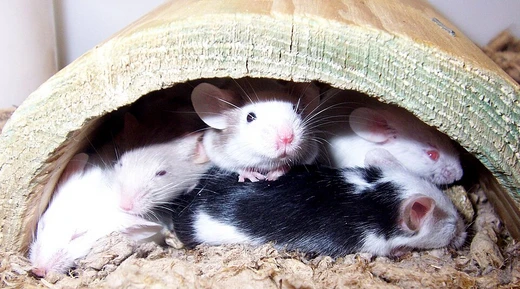
Peromyscus
New World rodents known as deer mice, carriers of hantaviruses.
Peromyscus is a genus of New World rodents commonly called deer mice, distinguished from house mice by larger eyes and two-tone coloring. The name derives from Greek words meaning 'booted mouse,' and they are known for agility and jumping ability. In the United States, Peromyscus is the most populous mammalian genus and is notable as a carrier of hantaviruses in the western states.
Quick Facts
- Type species
- Peromyscus arboreus
Facts from the source article.
Did You Know?
- The common name 'deer mouse' was coined in 1833, referencing both the animal's agility and its two-toned coloring.
- An American scientist once asked, 'How do you go out there and vaccinate a bunch of deer mice against Hantavirus by hand?'
Use as a laboratory animal
Peromyscus species are easy to breed and keep in captivity, though they are more energetic and harder to handle than the laboratory mouse Mus musculus. They are favored over M. musculus and the laboratory rat for studies of infectious diseases, phylogeography, speciation, chromosomes, genetics, ecology, population genetics, conservation, evolution, and repetitive-movement disorders. In aging research, Peromyscus species are useful because they have maximum lifespans of 5–7 years, compared to the 3-year maximum of ad libitum-fed laboratory strains or wild-caught M. musculus.
The Peromyscus Genetic Stock Center at the University of South Carolina, established by Professor Wallace Dawson in 1985, maintains populations of several species including Peromyscus californicus, P. maniculatus, P. melanophrys, P. eremicus, and P. aztecus, with mutations affecting behavior, biochemistry, and coat color. In 2017, Rocky Mountain Laboratories started a deer mouse colony for research on self-spreading vaccines, and SARS-CoV-2 transmits efficiently in deer mice.
More in Rodents And Small Mammals
Spotted an error? Know more?
Reader corrections go straight into our review queue. Suggest an edit · How this site is sourced