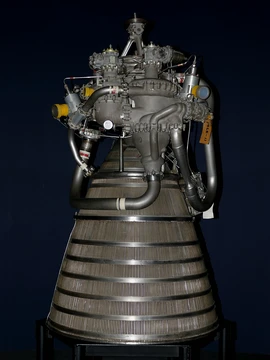
Rocketdyne H-1
Liquid-propellant engine used on Saturn I and Saturn IB first stages.
Last updated
The H-1 was a liquid-fueled rocket engine, burning LOX and RP-1 to generate 205,000 pounds of thrust. It powered the first stages of the Saturn I and Saturn IB rockets, with eight engines clustered together. Following the Apollo program, leftover H-1s were modified and sold as the RS-27, debuting on the Delta 2000 in 1974.
History
The H-1 is one of a series of engines developed from the wartime V-2 ballistic missile. North American Aviation (NAA) was given several 264.9 kN V-2 engines to examine and convert from metric to SAE measurements, forming their Propulsion Division, later Rocketdyne. Engineers studying the V-2 documentation came across plans to improve the engine using a new waterfall fuel injector, which the Germans had been unable to make work. NAA engineers solved the problem, raising thrust to 75000 lbf, then 78000 lbf for the Redstone missile.
NAA also worked on the SM-64 Navaho cruise missile, which used the same engine as a booster. The Air Force demanded higher performance, leading to larger missiles and boosters, and by the early 1950s the engine had been enlarged to 120000 lbf. These designs burned ethanol, but other fuels were experimented with, including kerosene, diesel oil, paint thinner, JP-4, and JP-5. In January 1953 Rocketdyne started the REAP program to convert these engines to a specific kerosene fuel, RP-1, officially specified in Military Specification MIL-R-25576 in 1954.
In 1955, the Air Force selected a JP-4 burning version for the Atlas missile. The Army requested a boost to 150000 lbf for the Jupiter missile, and the Air Force used the same version for the Thor, producing the Rocketdyne S-3D (or LR-79). All these engines shared a waterfall injector and a complex system for starting the turbopumps using secondary fuel tanks and electropneumatic valves.
Description
The H-1, like other early Rocketdyne engines, featured a waterfall injector, turbopump-fed propellant delivery, and regenerative cooling via its own fuel. Its combustion chamber was constructed from 292 stainless steel tubes brazed together in a furnace. In contrast to the restartable J-2 used on the S-IVB stage, the H-1 was a single-start design. While it could undergo multiple static test firings before a mission, it could not be reignited in flight because certain startup components were single-use.
The turbopumps were spun up by a Solid Propellant Gas Generator (SPGG), a small solid rocket motor that required replacement after each use. To initiate ignition, a 500V AC current fired the SPGG.
Hot gas from the solid propellant accumulated until pressure reached 600–700 psi, at which point a bursting diaphragm released it into the turbine. This drove the fuel turbopumps, starting the flow of RP-1 and LOX into the engine and gas generator. Once combustion began in the gas generator, its exhaust sustained the turbopumps until shutdown.
More in Rocket Engines of the United States
Sources
Compiled from Wikipedia and the sources listed below. Text from Wikipedia is available under CC BY-SA 4.0; this entry is adapted from it.
- Wikipedia: Rocketdyne H-1 (CC BY-SA 4.0).
Spotted an error? Know more?
Reader corrections go straight into our review queue. Suggest an edit · How this site is sourced