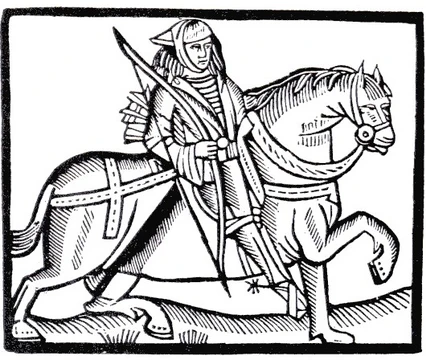
Robin Hood and the Bishop
A Robin Hood ballad of disguise and a bishop's comeuppance.
Last updated
Robin Hood and the Bishop (Roud 3955, Child 143) is an English-language folk song that recounts an adventure of Robin Hood. It survives as a late seventeenth-century English broadside ballad and is one of several ballads about the medieval folk hero included in the Child ballad collection, a major compilation of traditional English ballads.
Quick Facts
- Roud number
- 3955
- Child number
- 143
- Type
- English-language folk song
- Form
- Broadside ballad
Facts from the source article.
Synopsis
One sunny day, Robin Hood walks through the forest seeking diversion and notices a proud bishop with his company. Away from his men, Robin fears the bishop will hang him if caught. He sees an old woman's house and asks for aid; because he had previously given her shoes and socks, she agrees to exchange her grey coat, spindle, and twine for his green mantle and arrows. Robin then finds his men; Little John mistakes him for a witch and nearly shoots an arrow, but Robin reveals himself.
Meanwhile, the bishop goes to the old woman's house, catches her thinking she is Robin, and they ride off. Ahead they see a hundred bow-men under a great green-wood tree; the old woman identifies them as Robin Hood and herself as an old woman. Robin stops the bishop, ties his horse to a tree, empties his five hundred pounds into his mantle, and is about to let him go when Little John demands the bishop say Mass. They tie him to a tree, force him to say Mass, then set him back on his horse with a sarcastic command to pray for Robin.
Historical and cultural significance
This ballad belongs to a group of Robin Hood ballads that, like many popular ballads collected by Francis James Child, were considered a threat to the Protestant religion in their time. Puritan writers such as Edward Dering in 1572 dismissed such tales as childish folly and witless devices. Child himself, writing of the Robin Hood ballads after A Gest of Robyn Hode, claimed that variations on the Robin met with his match theme are sometimes wearisome or sickening, and that a considerable part of the Robin Hood poetry looks like char-work done for the petty press.
He also called the Roxburghe and Pepys collections veritable dung-hills in which only after sickening grubbing one finds a very moderate jewel. However, the broadsides are significant as markers of current events and popular trends, as English jurist John Selden observed: more solid things do not show the complexion of the times so well as ballads and libels. Historian J. C. Holt has argued that the Robin Hood tales developed among the gentry, portraying a yeoman rather than a peasant, and do not mention peasants' complaints such as oppressive taxes; Robin Hood does not rebel against societal standards but upholds them by being munificent, devout, and affable.
Did You Know?
- The English Broadside Ballad Archive at the University of California, Santa Barbara holds four seventeenth-century broadside ballad versions of this tale.
- One version is in the Euing collection at the Glasgow University Library (303).
- Two versions are in the Pepys collection at Magdalene College at the University of Cambridge (2.109 and 2.122).
More in Robin Hood Ballads
Sources
Compiled from Wikipedia and the sources listed below. Text from Wikipedia is available under CC BY-SA 4.0; this entry is adapted from it.
- Wikipedia: Robin Hood and the Bishop (CC BY-SA 4.0).
Spotted an error? Know more?
Reader corrections go straight into our review queue. Suggest an edit · How this site is sourced