Aikyam
Aikyam is the oneness of self and ultimate reality.
Aikyam (Sanskrit: ऐक्यम्) denotes oneness, unity, harmony, or identity. In Vedantic thought, it refers to the fundamental identity of the individual self (Atman) and the universal reality (Brahman), a core teaching of the Upanishads.
Quick Facts
- Meaning
- oneness
- unity
- harmony
- identity
- Key concept
- identity of individual self and Brahman (jīvātma paramātma aikyam)
Facts from the source article.
Did You Know?
- According to Madhavacharya, aikyam cannot be real at all; if it were, absolutism would have vanished.
- Nagarjuna explains that if there were identity of cause and effect, then there would be oneness of producer and produce; if there were difference, the cause would equal a non-cause.
Vedic purport
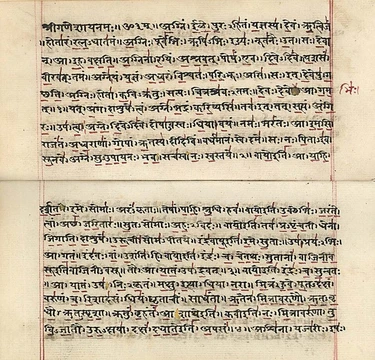
The Vedas, as oral tradition, are called Śruti, and the Upanishads, known as Vedanta, are considered the destroyer of bondage. The oneness of the Individual Self and the Universal Self (jīvātma paramātma aikyam) is regarded as Śrutisara, the ultimate purport of the Vedas. The compound word Brahman atman aikyam describes the fundamental dogma of the Vedanta system. The Vedic Rishis state that the faith of all men conforms to their mental constitution, and they speak of two Unmanifests: one that transforms itself and causes other transformations, and another that supports the former, though there is no real difference between them.
Rishi Dirghatamas, in Rig Veda I.163.4, prays to Agni, saying that the place of Agni's origin or birth is the same as that of the speaker; if Agni is endowed with strength, the speaker possesses the same strength; and if Agni exists in three states or forms (gross, subtle, and causal), so do water, earth, and all objects dispersed in space. This awareness of sameness, which is the awareness of oneness, is the knowledge of Reality, the true knowledge of existence, by which the true seeker ceases to see difference in the world of variety, seeing difference only as names echoing in the mind.
Rishi Venobhargavah, in Rig Veda IX.85.9, speaks of the same knowledge of oneness, describing the stars and celestial luminaries shining because of the light of the self-effulgent Brahman, who is pure, the source of amrita desired by the learned, the giver of happiness, and the deliverer as the only source of immortality.
Vedanta contention
Vedantasara explains that the subject (visheya) is the identity of the individual self and Brahman, which is of the nature of Pure Intelligence, wherein all ideas of separation and variety are effaced, and is to be realized as the goal all Vedas declare. The connection (sambandha) is the relation between that identity to be realized and the evidence of the Upanishads that establishes it. Sankara states that the notion of a multitude of souls is valid only at the empirical level; while the Atman stays within the limits of the body, emotions, and intellect, there cannot be absolute unity (sarvārtha-aikyam) with Brahman, and the soul is only the reflection of the higher ātman.
There is only one reality; that about which cognition does not change is sat (real), and that about which cognition changes or is negated is asat (unreal). The Atman or Brahman alone, being unchangeable and un-negatable, is the only sat or Reality.
More in Rigveda
Spotted an error? Know more?
Reader corrections go straight into our review queue. Suggest an edit · How this site is sourced