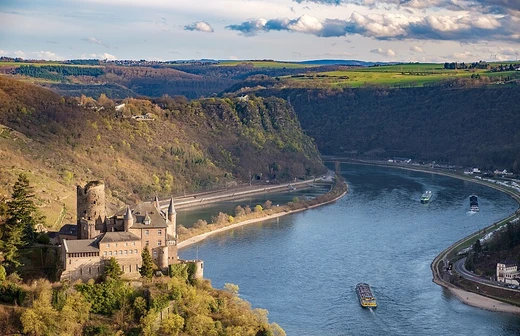
West Rhine Railway
Scenic double-track electrified line along the left bank of the Rhine.

via Wikipedia: West Rhine Railway · see source
The West Rhine railway, known in German as the Linke Rheinstrecke, is a 185-kilometre double-track electrified line running from Cologne through Bonn, Koblenz, and Bingen to Mainz. It hugs the Rhine's left bank, with 160 km/h speeds possible between Cologne and Koblenz and between Bingen and Mainz. Through the winding Rhine Gorge, a UNESCO World Heritage Site, the line's speed is limited.
Quick Facts
- Other names
- Left Rhine Railway
- Start
- Cologne
- Electrification
- 15 kV/16.7 Hz AC Overhead catenary
- Speed
- 160 km/h / 99.4 mph (max)
- Locale
- North Rhine-Westphalia
- Rhineland-Palatinate and Hesse
- Germany
Facts from the source article.
History
The first section of the line opened on 15 February 1844, by the Bonn–Cologne Railway Company between the former station of Cologne St. Pantaleon and Bonn. It was extended on 21 January 1856 south to Rolandseck station and in 1859 north to the Cologne central station. After the takeover by the Rhenish Railway Company on 1 January 1857, the line was extended in 1858 through Remagen and Andernach and crossed the Moselle to Koblenz via the Moselle railway bridge, opened on 11 November 1858.
The particularly beautiful section between Koblenz and Bingerbrück (now called Bingen Hbf), which runs close to the river through this winding section of the Rhine Valley, was opened on 15 December 1859. Bingerbrück station was at the time on the border of the Kingdom of Prussia and the Grand Duchy of Hesse, connecting with the Rhine-Main line of the Hessian Ludwig Railway, opened on 17 October 1859, and the Nahe Valley Railway to Saarbrücken. In Koblenz, the Pfaffendorf Bridge over the Rhine was completed in 1864 to connect to the Right Rhine line.
With the construction of the Horchheim Bridge south of Koblenz, opened in 1879, and the Urmitz Bridge north of Koblenz, opened in 1918, this bridge was progressively given over to pedestrian, vehicular and, eventually, tram traffic; the last train used it at the outbreak of World War I in August 1914. From 1861 the Nassau State Railways established a train ferry between Bingen and Rüdesheim am Rhein; this was converted to a passenger ferry in 1900.
From 1870 to 1914 another train ferry operated between Bonn and Oberkassel to transfer trains between the West Rhine line and the East Rhine railway. During the First World War three strategic Rhine crossings were built: the Hindenburg Bridge (built 1913–1915), the Crown Prince Wilhelm Bridge (built 1916–1918), and the Ludendorff Bridge (built 1916–1919). All three were destroyed in World War II; only the Crown Prince Wilhelm Bridge was rebuilt, as the Urmitz bridge, in 1954. The line was electrified in 1959.
Current operations{{when|date=January 2017}}
Until the opening of the Cologne-Frankfurt high-speed rail line, the West Rhine line was one of the busiest in Germany, carrying the fastest trains between the Rhineland and southern Germany. Its importance for long-distance travel has since diminished. The line now generally carries one InterCity or Intercity-Express service per hour (stopping at Bonn, Koblenz, and Mainz), one Regional-Express per hour (the Rhein-Express to Koblenz Hauptbahnhof), one RegionalBahn per hour in each direction, and many freight trains. Before the high-speed line opened, freight trains were largely restricted to the Right Rhine line; with more train paths available on the Left Rhine line, many are now routed over it.
Current operations
Until the opening of the Cologne-Frankfurt high-speed rail line, the line was one of the busiest in Germany. The fastest trains connecting the Rhineland and southern Germany ran on the line. The importance of the line for long distance travel has diminished since the opening of the high-speed line. The line is now generally used by one InterCity or Intercity-Express service (stopping at Bonn, Koblenz and Mainz) each hour, one Regional-Express train each hour (the Rhein-Express to Koblenz Hauptbahnhof), one RegionalBahn (stopping) train each hour in each direction, as well as by many freight trains. Before the opening of the high-speed line, freight trains were largely restricted to the Right Rhine line, but with the increased availability of train paths on the Left Rhine line many of them are now routed over it.
More in Rhine Gorge
Spotted an error? Know more?
Reader corrections go straight into our review queue. Suggest an edit · How this site is sourced